
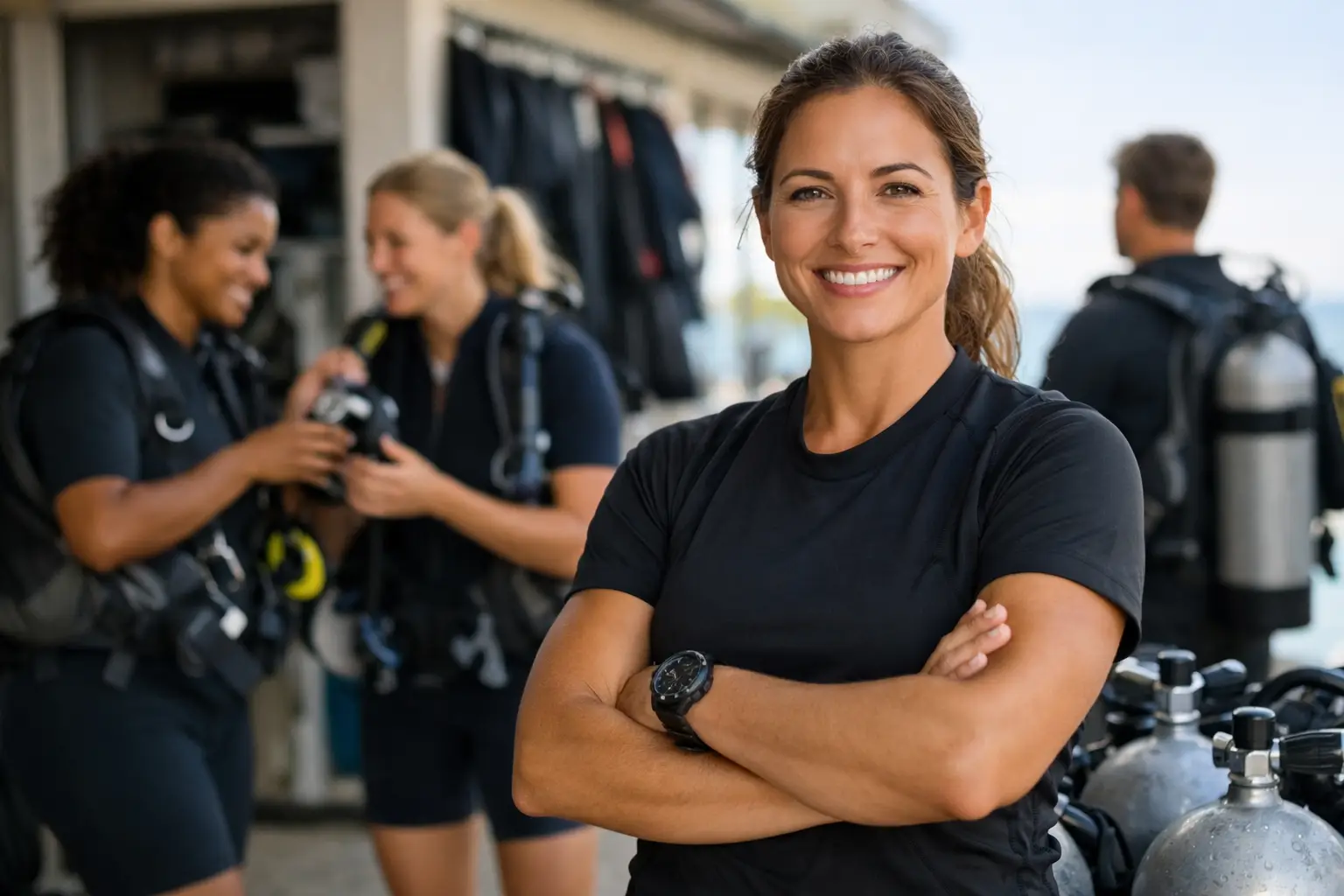
The first time you descend into a cenote or roll backward from a boat over the Caribbean, the quality of the team around you changes everything. The real female led dive center benefits are not about assuming women dive one way and men another. They are about choosing a business where leadership, communication, training standards, and guest care are intentionally built to help more people feel capable underwater.
For a first-time diver, that can mean asking a question without feeling rushed. For a future Divemaster, it can mean seeing a career path that feels attainable. For every diver, it can mean a team that treats safety, environmental responsibility, and personal progress as connected parts of the same experience.
Female Led Dive Center Benefits Start With Culture
A dive center reflects the decisions made long before fins touch the water. Its leaders set expectations for briefings, equipment preparation, instructor development, customer communication, and how staff respond when a diver is nervous, cold, tired, or simply not having a great day.
Female leadership can bring a valuable perspective to those decisions, particularly in an industry where many travelers have historically felt they needed to prove they were tough enough, experienced enough, or relaxed enough to belong. A well-run female-led operation can replace that pressure with clear standards and real encouragement. You are still expected to follow procedures. You are still challenged to develop excellent skills. But you are not made to feel small for needing support along the way.
That distinction matters. Scuba diving is an adventure sport, but it is also a discipline built on preparation, judgment, and trust. The strongest dive culture is not the loudest one. It is the one where every person understands the plan, feels comfortable speaking up, and knows the team will take concerns seriously.
Better Communication Makes Safer Divers
Good dive leadership does not eliminate risk. No responsible professional would promise that. It manages risk through planning, conservative decisions, skill practice, equipment checks, weather awareness, and honest communication.
Many guests notice the difference in the details: a thorough pre-dive check rather than a rushed one, an instructor who explains why a skill matters, or a guide who asks how you are feeling before the descent. These habits are not exclusive to women, and exceptional dive professionals of every gender practice them. Yet female-led teams often make intentional, guest-centered communication a visible part of their service culture.
For beginners, that can be transformative. Anxiety is common before a first open-water descent, especially when you are learning buoyancy, breathing from a regulator, and communicating without words. A patient instructor can break the process into manageable steps, give you room to practice, and help you build confidence without pretending nerves do not exist.
For experienced divers, communication remains just as important. Cave and technical training, deeper profiles, current, overhead environments, and multi-day professional programs demand direct feedback. The goal is never empty reassurance. It is to receive precise coaching, understand your limits, and become a more self-reliant diver.
Confidence Is Built, Not Handed Out
The best instructors do not tell every student they are ready before they are. They create the conditions for readiness through repetition, calm correction, and progressive challenges.
A female-led dive center may be especially appealing if you have had an experience where questions were brushed aside or confidence was confused with competence. In a strong training environment, there is room for both ambition and humility. You can want to become an instructor, explore cenotes, or pursue technical diving while also acknowledging that growth takes time.
That approach serves divers of all identities. It is also powerful for women and girls who want to see capable female professionals leading boats, teaching courses, managing logistics, repairing gear, guiding dives, and setting the standard for a serious dive operation.
Representation Can Change What Feels Possible
Seeing someone like yourself in a leadership role is not a marketing detail. It can change the question from “Do I belong here?” to “What could I become here?”
For travelers booking their first experience, a female-led team can feel more approachable, especially for solo women, couples, families, and groups with mixed comfort levels in the water. It signals that the center has considered different guest needs rather than designing every experience around the most confident person in the group.
For career-minded divers, representation carries even more weight. A Divemaster or Instructor program is not just a vacation activity. It is a professional step that requires stamina, decision-making, teaching ability, and consistent standards. Learning from women who have built careers in diving offers a practical example of what professional leadership looks like – not as an exception, but as an established reality.
At Infinity2Diving, female-led ownership and operations sit alongside professional PADI education, from first breaths underwater to instructor-level development. That combination matters because inspiration is most valuable when it is backed by real systems, experienced mentorship, and high standards.
A More Personal Experience Without Lowering Standards
Personalized service has become an overused travel promise. In diving, it should mean something concrete. It means your center pays attention to your certification level, recent experience, medical considerations, goals, and comfort in the conditions planned for the day.
Perhaps you are a certified diver who has never entered a cenote. You may need more than a beautiful description of the light beams and formations. You need a proper briefing on buoyancy control, trim, finning, environmental care, and the limits of the specific dive. Or perhaps you are considering a Discover Scuba Diving experience and worry that you will slow everyone down. A professional team should organize the day so your learning needs are part of the plan, not an inconvenience.
This is where the female led dive center benefits become tangible. A leadership culture centered on attentive service can make the experience feel more personal while maintaining the boundaries that keep it safe. The answer is not always “yes.” Sometimes the most caring decision is to postpone a dive, choose an easier site, repeat a skill, or recommend more training before a more demanding adventure.
That is not a loss of adventure. It is how sustainable adventure is built.
Conservation Becomes Part of the Experience
A meaningful dive is not only about what you see. It is also about how you move through the underwater world.
In the Riviera Maya, divers enter environments that deserve care: coral reefs, freshwater cenotes, marine habitats, and coastal ecosystems shaped by both natural forces and human impact. Conservation-minded centers teach practical habits rather than relying on vague promises. Good buoyancy protects delicate reef life. Secure equipment prevents contact with formations and coral. Thoughtful route planning, waste reduction, and respect for local regulations all matter.
Female leadership often intersects naturally with community-minded and care-oriented values, but the result should be measured by action, not labels. Ask how a center protects dive sites, trains guests to reduce impact, and supports a culture where staff can speak up when practices fall short.
The best operators make conservation part of the briefing, part of the training, and part of the memory you take home. You leave with photographs, stories, and a clearer understanding that access to extraordinary places comes with responsibility.
What to Look For Beyond the Label
Choosing a female-led center is a meaningful preference, but it should not be your only criterion. Leadership identity does not automatically guarantee exceptional instruction, and a center should welcome questions about its actual practices.
Look for transparent inclusions and pricing, well-maintained equipment, appropriate group sizes, clear cancellation and weather policies, and instructors qualified for the dives or courses they teach. Ask how the team handles nervous divers, when they call a dive, and how they match guests to sites. For advanced or professional training, ask about the schedule, student support, performance expectations, and the experience of the teaching team.
It also depends on what you want from the trip. If you are seeking a fast, high-volume outing with minimal instruction, a relationship-driven training center may feel more detailed than necessary. If you want to develop skills, explore unfamiliar environments with confidence, or take a serious next step in diving, that extra attention is often exactly the point.
Choose the team that makes you feel both welcome and accountable. The right dive center will celebrate your excitement, respect your boundaries, and challenge you to become the kind of diver who protects the places you came to see.