
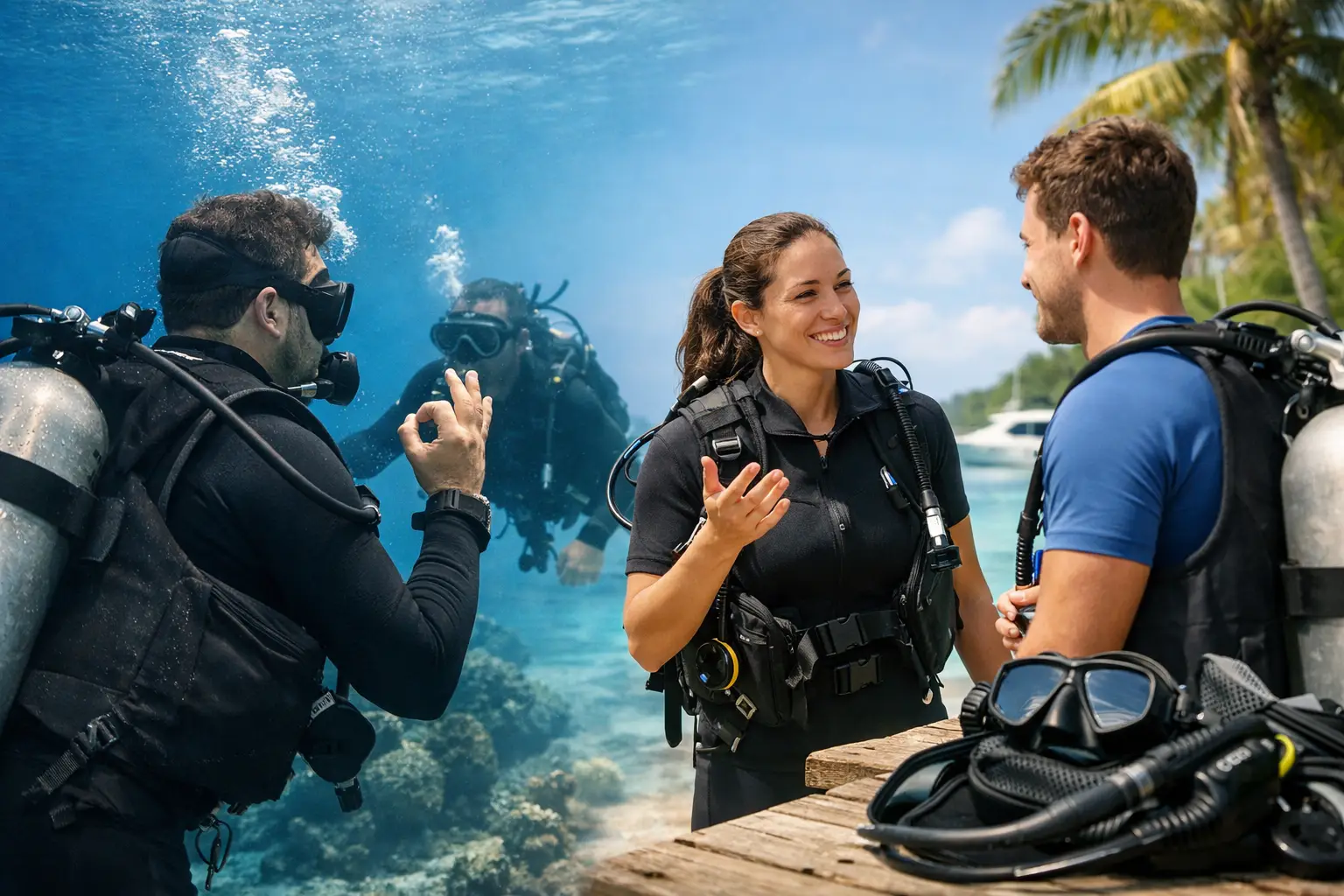
A scuba career is not built by collecting certifications as quickly as possible. It is built through calm decision-making, excellent habits, real-world water time, and the ability to make other people feel safe enough to enjoy one of the biggest adventures of their lives. This guide to a scuba career path will help you understand what the journey actually looks like, from your first open-water skills to leading and teaching divers professionally.
Start With the Career You Actually Want
The first question is not, “How fast can I become an instructor?” It is, “What kind of life do I want scuba diving to support?” Some professionals want to guide reef and cenote dives in a destination they love. Others want to teach new divers, travel between seasonal jobs, work on liveaboards, or eventually lead technical and cave training. Those routes overlap, but they do not require the same pace, experience, or investment.
A professional diving career can be deeply rewarding, but it is still work. Your days may begin before sunrise with equipment preparation and end with rinsing tanks, completing paperwork, and checking in with students. You will carry gear, manage changing conditions, solve small problems before they become big ones, and place safety ahead of every schedule. If that responsibility energizes you, you are in the right place.
It is also worth being realistic about income. Early-career dive work can be seasonal, and pay varies widely by country, role, language skills, and whether housing, meals, or commissions are included. The strongest long-term professionals build more than diving ability: they become reliable team members, confident communicators, skilled teachers, and knowledgeable local guides.
Build a Strong Recreational Foundation First
Every professional starts as a recreational diver. Your first goal should be comfort, not speed. An Open Water Diver course teaches the essential skills, but true confidence comes from practicing those skills in different conditions, with different buddies, after the course card is issued.
Move Beyond the Minimum
After Open Water, the natural next step is Advanced Open Water Diver. This course gives you exposure to deeper diving, navigation, buoyancy work, and other adventure dives. It is not about chasing depth for its own sake. It is about learning how your body, equipment, awareness, and decision-making change as a dive becomes more complex.
Specialty training can then shape your interests. Enriched Air Diver is valuable for divers who want to make the most of repetitive diving days. Deep Diver, Wreck Diver, Night Diver, and Peak Performance Buoyancy can all strengthen your skills. In the Riviera Maya, cavern and cenote experiences can be unforgettable, but they should be approached with the right training, a conservative mindset, and respect for overhead-environment limits.
Become a Rescue Diver Before You Think Like a Pro
Rescue Diver is often the point where a diver’s perspective changes. You stop focusing only on your own descent, mask, air supply, and photos. You learn to notice stress early, assist effectively, manage scenarios, and think one step ahead. Emergency First Response or equivalent CPR and first-aid training is part of that foundation.
Do not treat Rescue as a box to check. Repeat the skills, ask for feedback, and become comfortable responding calmly. Future Divemasters and Instructors need that calm to be genuine, not performed.
Choose Between Divemaster and Instructor Goals
The PADI professional path is progressive for a reason. Each level asks you to earn more responsibility and demonstrate more consistent judgment.
A PADI Divemaster is the first professional rating. Divemasters can supervise certain diving activities, assist instructors, lead certified divers where appropriate, and become a key part of a dive center’s daily operations. For many people, Divemaster is the dream job: guiding guests through spectacular sites, sharing local knowledge, and helping nervous divers become confident underwater.
The course is also a serious apprenticeship. You will refine your skills, complete stamina exercises, map sites, practice briefings, assist with courses, and learn what happens behind the scenes at a professional dive operation. Requirements include a minimum age, medical fitness, emergency-care credentials, rescue certification, and logged dives. Standards can change, so confirm the current prerequisites before planning your timeline.
If teaching is your goal, Divemaster leads toward the PADI Instructor Development Course, Instructor Exam, and eventually the Open Water Scuba Instructor rating. Instructors do far more than demonstrate a mask-clearing skill. They translate standards into understandable coaching, evaluate performance fairly, manage groups with different confidence levels, and create a learning environment where students can ask questions without embarrassment.
After becoming an instructor, continuing education can lead toward specialty instructor ratings, Master Scuba Diver Trainer, IDC Staff Instructor, and other professional development opportunities. Technical and cave routes are separate, more demanding tracks that require a strong base of experience and specialized training. There is no prize for rushing into them.
Treat Logged Dives as Learning, Not a Number
Dive totals matter because experience matters, but a logbook number alone does not make someone ready to lead others. Fifty dives completed at one easy site are different from fifty dives that include boat procedures, current, night conditions, navigation challenges, altitude considerations, or changing visibility.
Build variety with intention. Keep notes about conditions, weighting, air consumption, equipment choices, marine life, and what you would do differently next time. This habit turns every dive into a lesson and gives you useful material when you begin briefing guests or helping students troubleshoot their buoyancy.
Your buoyancy deserves special attention. A dive professional who kneels on coral, stirs up the bottom, or struggles to hold position sends the wrong message. Excellent trim and propulsion protect fragile environments, conserve energy, and show students what controlled diving looks like.
Develop the Skills That Certifications Cannot Fully Teach
The best dive professionals combine technical competence with hospitality. Guests may remember the sea turtle or the light beams in a cenote, but they also remember who helped them feel capable enough to enjoy it.
Communication is central to that experience. You need to give briefings that are clear without being overwhelming, adapt explanations for a first-time diver or an experienced traveler, and communicate with warmth when someone is anxious. Additional language skills are a meaningful advantage in an international destination, especially Spanish alongside English.
You also need professionalism above and below the surface. Be on time. Maintain your equipment. Know your limits. Never pressure someone into a dive they are not ready to make. Respect local regulations, site rules, and the team whose work makes every excursion possible. Ocean conservation is not a marketing line when you work in diving. It appears in your buoyancy, your briefings, your waste choices, and the standards you set for your guests.
Plan Your Training Time and Budget Honestly
A career path can take months or several years. It depends on where you begin, how often you dive, whether you train full-time, and how much real experience you gain between courses. Someone arriving in Tulum with no certification may choose a concentrated progression, while a working diver may spread training across several trips. Both approaches can work.
Budget beyond course tuition. Plan for medical exams if required, learning materials, equipment, insurance, accommodation, meals, transportation, and the time needed to log dives. Ask what is included before enrolling. A lower headline price can become expensive if core training dives, equipment, fees, or materials are added later.
Training in a destination with diverse environments can add real value when it is done responsibly. Reef dives help you practice guiding and awareness in open water, while cenote diving can sharpen buoyancy, light discipline, and respect for site-specific procedures. At Infinity2Diving, career-track training is designed to pair recognized PADI development with the kind of close mentorship that helps future professionals grow into the role.
Build a Reputation Before You Apply for a Job
Your reputation starts during training. Be the candidate who arrives prepared, receives feedback well, helps without being asked, and keeps learning after the course day ends. Instructors and dive center managers notice those qualities.
When you are ready to seek work, present more than your certifications. Keep a clean, accurate dive log and a professional resume that includes languages, customer-service experience, mechanical or boat skills, first aid, and any relevant specialties. Be honest about your experience. A dependable new Divemaster who asks smart questions is far more valuable than someone pretending to know everything.
The ocean will keep teaching you long after you become a professional. Choose the next course, job, or mentor based on the kind of diver you want to become: prepared, humble, capable, and generous with the people who trust you underwater.