
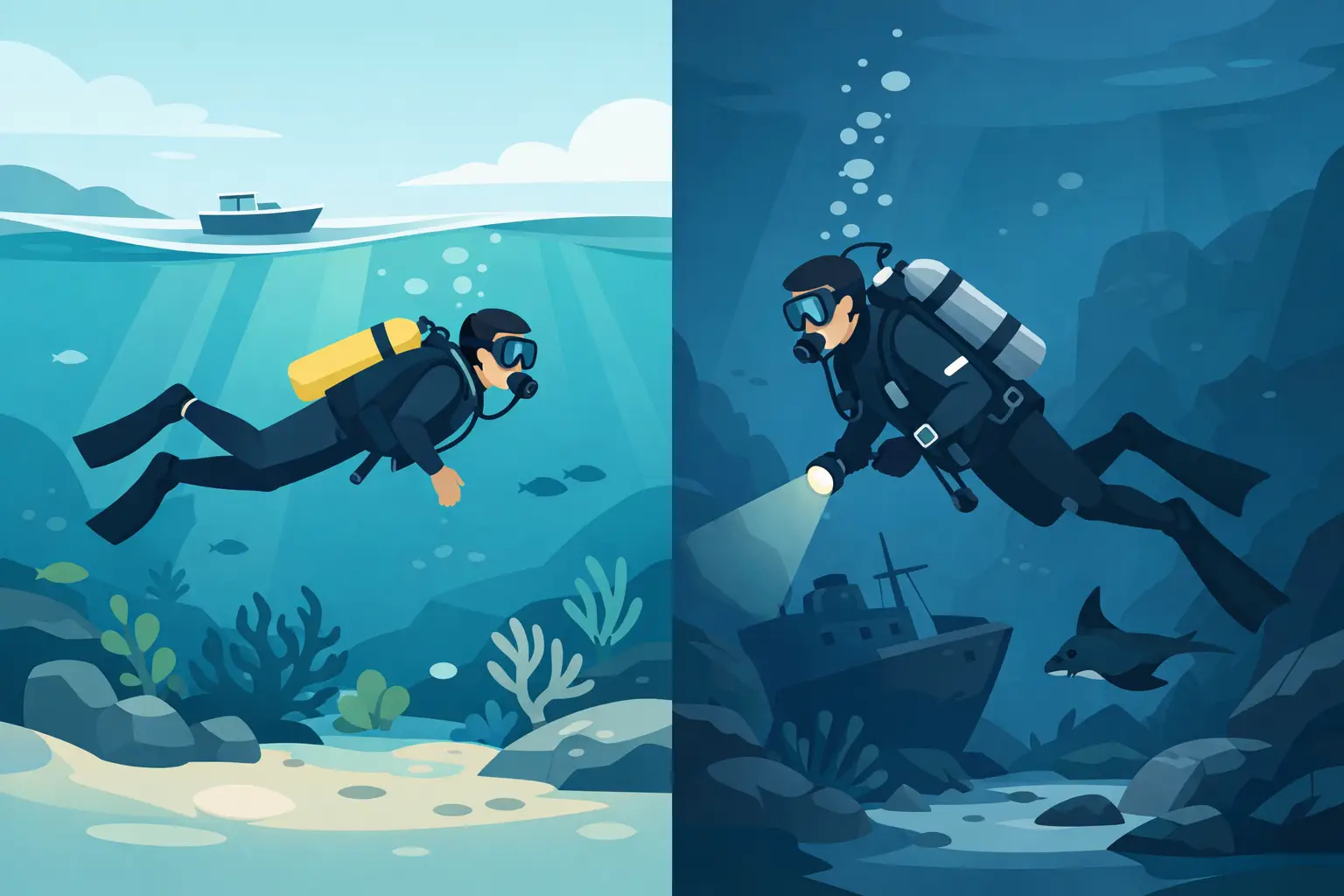
You booked a trip to Tulum, you are staring at turquoise water and cenote photos, and now the question gets real: open water vs advanced certification – which one actually makes sense for you right now? The answer depends less on what sounds more impressive and more on what kind of diver you are, where you want to go next, and how confident you want to feel underwater.
A lot of divers assume Advanced Open Water is simply the “better” version of Open Water. It is not. These are two different points on the same path. One gives you your foundation. The other builds range, confidence, and access. If you choose the right one at the right time, your training feels exciting and empowering. If you choose the wrong one, it can feel rushed or underused.
Open water vs advanced certification: the real difference
Open Water Diver is your entry-level scuba certification. It is designed for people who are brand new to diving or have little experience and want to become certified to dive with a buddy. This course teaches the core skills every diver needs: buoyancy basics, mask clearing, regulator recovery, equipment setup, underwater communication, safety procedures, and how to manage a dive within recreational limits.
Advanced Open Water is not for total beginners. It is a continuing education course for certified divers who want to expand their skills and experience under instructor supervision. Instead of focusing on the absolute basics, it introduces you to new types of diving and helps you become more capable in changing conditions. You complete adventure dives that typically include deep diving and underwater navigation, plus electives such as peak performance buoyancy, drift, night, wreck, or boat diving depending on location.
That distinction matters. Open Water answers, “Can I dive safely as a certified recreational diver?” Advanced answers, “Can I handle more depth, more task loading, and more varied environments with better control?”
Who should choose Open Water first
If you have never been certified, Open Water is the correct starting point. There is no shortcut around developing the fundamentals, and honestly, there should not be. Good diving starts with comfort in the water, strong habits, and a calm, methodical approach to problem-solving.
Open Water is ideal for travelers who want to begin diving during a vacation, ocean lovers ready to turn curiosity into a real skill, and future adventure divers who know this is the start of something bigger. It is also the better choice if you feel excited about scuba but still a little nervous. A well-taught Open Water course should leave you feeling challenged in a good way, not overwhelmed.
The biggest benefit of Open Water is confidence built on repetition. You are not just checking off skills. You are learning how your body responds underwater, how to breathe in a relaxed way, how to maintain neutral buoyancy, and how to stay aware of your buddy and surroundings. Those habits become the platform for every course you take after.
With Open Water certification, you can typically dive to 60 feet within recreational limits, depending on training standards and age. That opens the door to many reef dives around the world and gives you the freedom to continue gaining experience as a certified diver.
Who should choose Advanced Open Water
Advanced Open Water makes sense if you are already certified and want to progress quickly with structure and purpose. Maybe you loved your first dives and do not want to stay at the beginner level. Maybe you are traveling somewhere with deeper sites, stronger current, boat diving, or cenotes and want training that helps you feel ready rather than just hopeful.
This course is especially valuable for divers who want broader access. In many destinations, depth limits, site conditions, and operator recommendations make advanced training more than a nice bonus. It can be the difference between sitting out a signature dive and joining it with the right preparation.
For many travelers, the strongest reason to take Advanced is not the card itself. It is what happens during training. You refine buoyancy. You practice navigation with more intention. You gain experience at depth with an instructor beside you. You start managing attention across multiple tasks instead of focusing only on yourself. That is where divers begin to feel smoother, calmer, and far more capable.
Advanced certification also usually raises your recommended maximum depth to 100 feet for adult divers. That does not mean every dive should be deep. It means you have trained for deeper recreational diving and understand the planning and awareness that come with it.
Open water vs advanced certification for Tulum diving
This is where the choice becomes very practical. Tulum is not just a place to get certified. It is a place where the kind of diver you are shapes the kind of underwater world you can experience.
If you are brand new, Open Water is an incredible way to begin. Warm water, beautiful marine life, and professional instruction can turn a vacation into the start of a lifelong passion. You can build your base on reef dives and emerge with skills that travel anywhere.
If you are already certified, Advanced can be a smart move in Tulum because this region rewards divers who want more range and precision. Deep diving, navigation, buoyancy control, and environment-specific experience matter here. Cenotes, for example, are not about racing through dramatic spaces for a photo. They demand excellent trim, calm movement, and respect for the environment. Advanced training does not replace specialized overhead environment training, but it can absolutely make you a more controlled and aware diver before you move into more challenging experiences.
That is one reason many traveling divers come to a training-focused center like Infinity2Diving instead of treating certification as a quick checkbox. In a destination this special, quality instruction changes the whole experience.
What many divers get wrong
A common mistake is assuming Open Water is “basic” and Advanced is only for elite divers. In reality, Open Water is foundational, and foundational does not mean small. Some of the most important skills in your entire dive life are learned there.
Another mistake is signing up for Advanced too early in the wrong mindset. You do not need hundreds of dives, but you should be ready to learn, not just collect a title. If your buoyancy is shaky, if you still feel anxious doing simple mask skills, or if you have not dived since your Open Water class years ago, a refresher or a few guided dives may be the best next move before starting Advanced.
There is also the opposite problem: waiting too long because you think Advanced sounds intimidating. It usually is not. For many divers, it is one of the most fun and motivating courses because you get exposed to different styles of diving without committing to a full specialty right away.
How to decide which certification fits you now
Ask yourself what is true today, not what sounds ambitious on paper. If you are not certified, start with Open Water. If you are certified and eager to expand your diving in a structured way, Advanced is likely the better fit.
Think about your next 12 months of diving. Are you planning tropical reef vacations, boat dives, deeper sites, or destination-specific adventures? Do you want to feel more independent and capable underwater? Are you considering future specialties, rescue training, or a professional path? If yes, Advanced often makes sense sooner rather than later.
Also be honest about your comfort level. Good training should stretch you, but it should not push you past the point where learning shuts down. The best course is the one that builds real confidence and keeps you excited to continue.
The bigger picture: certification is a path, not a finish line
The debate around open water vs advanced certification sometimes misses the point. These courses are not competing products. They are connected steps in a progression that can take you from first breath underwater to some of the most unforgettable experiences of your life.
Open Water is where you become a diver. Advanced is where you start becoming your kind of diver.
That might mean a traveler who falls in love with reef diving. It might mean someone who wants to move toward wrecks, night dives, or drift dives. It might even be the beginning of a much bigger dream, from Rescue Diver to Divemaster and beyond. Every level has value when it matches your goals and is taught with care.
Choose the course that fits where you are, then give yourself permission to keep growing. The ocean has a way of meeting you exactly at your level and then inviting you one step further.