
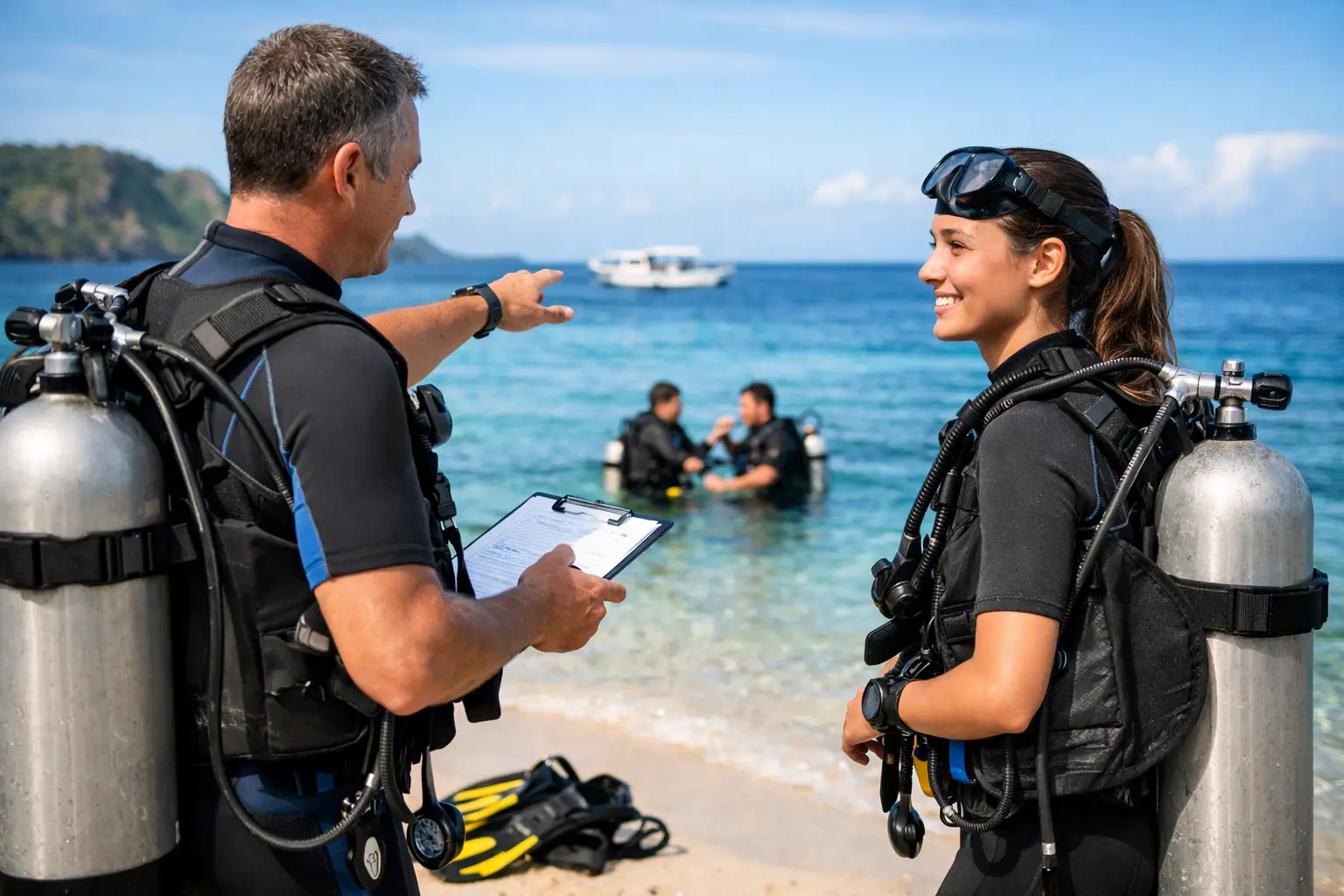
You do not become a great scuba instructor by passing one exam and buying a new set of gear. Real instructor growth happens when you learn to teach clearly, solve problems calmly, and lead divers with confidence in changing conditions. That is exactly why a guide to PADI instructor development matters – especially if you are looking at this path not as a vacation add-on, but as the start of a serious professional career.
For many divers, the instructor route begins with a simple idea: I love diving and want to share it. That is a strong start, but love for diving is not the same as readiness to teach. PADI instructor development is designed to close that gap. It takes a skilled diver and shapes them into a dive educator who can manage risk, build student confidence, and represent the standards of the largest recreational dive training organization in the world.
What PADI instructor development really includes
When people talk about becoming a PADI Instructor, they often mean the Instructor Development Course, or IDC. That is the core program, but instructor development is broader than a single course. It includes your preparation as a Divemaster, your ability to demonstrate skills at a high level, your understanding of teaching systems, and the way you handle real students in real water.
The IDC itself is typically divided into two parts: the Assistant Instructor course and the Open Water Scuba Instructor program. After that comes the Instructor Examination, often called the IE. Passing the IE is the milestone people focus on, and for good reason, but it is not the full story. The best candidates arrive prepared, and the best new instructors keep developing after certification.
That distinction matters. If your goal is just to pass, you can often scrape through with enough short-term study and repetition. If your goal is to build a career, you need training that develops judgment, professionalism, and consistency under pressure.
Who this guide to PADI instructor development is for
This path fits a few different kinds of divers. Some are career changers ready to leave an office job and work in the ocean. Others are long-term travelers who want a portable professional credential. Some are local dive professionals building a full-time career in tourism, education, or conservation. And some simply want to reach the highest level they can within recreational diving.
What they have in common is commitment. Instructor development is not casual. It demands time, study, watermanship, stamina, and humility. If you enjoy feedback, want to improve, and care about how students experience the underwater world, you are already thinking like a professional.
The path before the IDC
Before you start instructor development, you need the required certifications and logged dives. In most cases, that means progressing through Open Water, Advanced Open Water, Rescue Diver, Emergency First Response or equivalent primary and secondary care training, and Divemaster. You also need medical clearance and enough dive experience to meet PADI prerequisites.
But there is the formal path, and then there is the smart path. The smart path is to arrive at the IDC with strong buoyancy, clean skill demonstrations, comfort in briefings, and experience in a range of environments. A diver who has only logged the minimum number of easy dives may technically qualify, but that does not always translate into instructor readiness.
That is where training location and mentorship can make a major difference. Learning in a destination with varied conditions, active student flow, and experienced Course Directors gives you more than a certification track. It gives you context.
What you actually learn during instructor development
At its best, the IDC teaches far more than standards memorization. You learn how to organize academic presentations, confined water sessions, and open water teaching scenarios. You practice evaluating student performance and correcting mistakes without overwhelming people. You also learn how to manage the pace of a course, maintain safety, and communicate in a way that helps different personalities learn.
This is one of the biggest surprises for Divemasters moving into instructor training. The role changes. As a Divemaster, you support certified divers and assist instructors. As an instructor, you are responsible for student progression and learning outcomes. You are not just guiding the experience. You are shaping it.
There is also a leadership shift. Students often arrive nervous, excited, distracted, or overly confident. You need to read the room, adapt your teaching, and keep standards intact. Good instructor development helps you become steady in those moments.
How long it takes and what affects the timeline
Most IDC programs run on a defined schedule, but the total journey depends on where you are starting from. If you are already an active Divemaster with strong skills, the transition may be fairly direct. If you need to refresh rescue skills, improve demonstrations, or build confidence in theory, you may need more preparation before the course starts.
This is one of those it depends moments that future instructors should take seriously. Fast is not always better. A compressed timeline can work for prepared candidates, but it can also create unnecessary stress for divers who need more coaching. A longer development path often leads to stronger exam performance and better first-year teaching results.
If you are training while traveling, destination logistics matter too. Time for study, pool sessions, open water practice, and decompression between training days all affect how well you absorb the material.
The cost question, and what value really looks like
Instructor development is an investment, and not just because of tuition. You may also need to budget for PADI materials, application fees, the Instructor Examination, equipment, insurance, accommodation, and lost income while you train.
That is why the cheapest option is not always the best option. A lower advertised course price can leave out important parts of the process. On the other hand, a higher all-inclusive package may reduce stress, simplify planning, and give you more contact time with trainers. For career-focused divers, value often comes from quality mentorship, realistic teaching practice, and post-course support, not just the number on the invoice.
A premium training center can be worth it if the instruction is strong, the standards are high, and the environment helps you grow. Infinity2Diving, for example, stands out in Tulum as the only PADI 5 Star Career Development Center, which matters if you want a place built not only for teaching courses but for developing professionals.
Choosing the right training environment
Location shapes learning more than many candidates expect. If you train somewhere with a high volume of students, diverse dive settings, and a culture of professional development, you will see more of the real job. That exposure helps you connect classroom theory to actual instructional work.
Tulum is especially attractive for divers who want a destination experience without sacrificing training quality. Reef diving, cenotes, travel energy, and a serious dive community create a setting that is both inspiring and practical. You are not isolated from the reasons people fall in love with diving in the first place.
Still, the best environment is not just beautiful. It should feel structured, safe, and supportive. You want a team that gives honest feedback, expects professionalism, and treats you like a future colleague rather than a quick course sale.
Common mistakes future instructors make
One mistake is focusing only on passing the IE. Yes, the exam matters. But if all your energy goes into test survival, you can miss the deeper skills that make the career sustainable. Another mistake is underestimating theory. Dive physics, physiology, skills sequencing, and standards knowledge all show up when you teach.
A third mistake is choosing a course based purely on convenience. If the training feels rushed, disorganized, or transactional, you may leave with a card but not much confidence. New instructors often discover that confidence comes from repetition, coaching, and time in front of students.
The last big mistake is assuming certification equals employability. Employers notice more than a fresh credential. They notice attitude, punctuality, teamwork, language skills, professionalism, and how you treat guests.
What happens after you become an instructor
Your development does not stop when you pass the IE. In many ways, it starts again. The first months of teaching are where your habits form. This is when specialties, practical experience, and mentorship become especially valuable.
Some instructors move into specialties quickly. Others focus on core teaching and building consistency. Some continue toward Master Scuba Diver Trainer, while others gain experience before advancing. There is no single perfect timeline. The right next step depends on your goals, the dive center you work with, and how much support you have around you.
If you want a long-term career, keep learning. Work with experienced instructors. Ask for feedback. Improve your briefings. Refine your demos. Pay attention to student psychology, not just standards. That is how good instructors become memorable ones.
A practical mindset for success
If you are considering this path, go in with clear eyes and real excitement. PADI instructor development is challenging, and that is part of its value. It asks you to become more disciplined, more aware, and more capable under pressure. It can also open the door to a life built around travel, teaching, community, and the ocean.
The strongest candidates are not always the loudest or the most experienced on paper. They are often the ones who stay coachable, prepare seriously, and care deeply about the student experience. If that sounds like you, this path can be much more than a new certification. It can be the moment your diving stops being only something you love and becomes something you lead others into with skill, responsibility, and heart.
Choose your training the way you would choose a dive buddy for a deep, complex descent – with trust, respect, and confidence in what happens when conditions change.