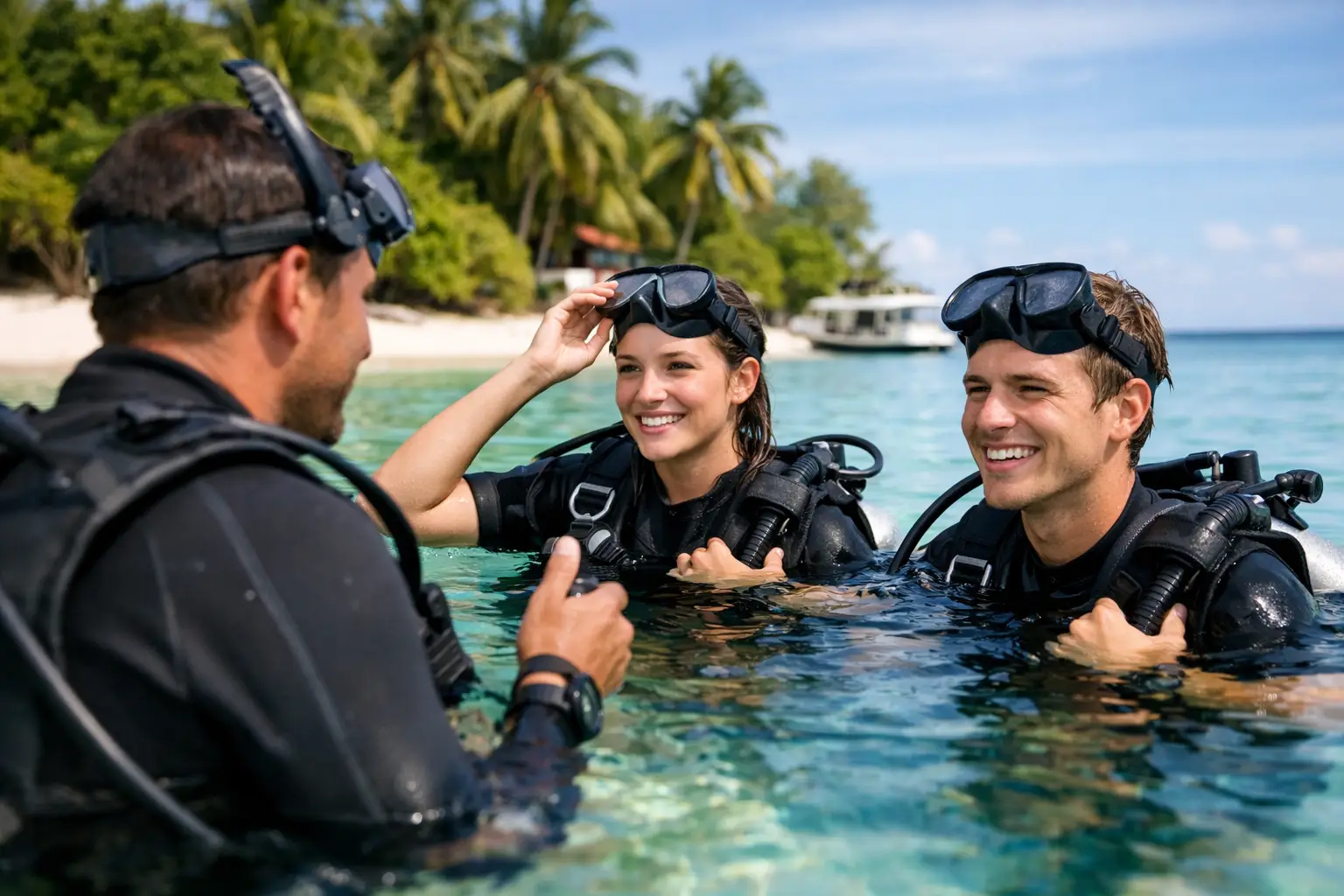
That first breath underwater changes people. One minute you are thinking about masks, fins, and whether you will remember anything from the briefing. The next, you are hovering over coral or descending into clear blue water thinking, I want to do this again. If you are researching the best scuba courses for beginners, the real question is not just which course sounds exciting. It is which one fits your confidence level, travel plans, budget, and goals.
For some people, the right starting point is a single supervised dive. For others, it makes more sense to go straight into a full certification and leave with a card that lets them dive around the world. The best choice depends on how comfortable you feel in the water, how much time you have on your trip, and whether you want a fun introduction or a real skill base you can build on.
How to choose the best scuba courses for beginners
A beginner course should do two things well. It should make you feel safe, and it should make you want to keep learning. If a course is heavy on pressure and light on support, it is probably not the right fit. If it feels exciting but skips the fundamentals, that is not a great sign either.
Strong beginner training balances calm instruction with genuine adventure. You want clear explanations, small groups, patient instructors, quality equipment, and a setting that matches your experience level. Warm water and good visibility help a lot, especially on a first course, because they reduce the mental load. When you are not battling cold, current, or poor visibility, you can focus on breathing, buoyancy, and enjoying the moment.
This is where destination training can be a smart move. Learning in a place with beautiful conditions often gives beginners a better first experience than trying to push through rough weather or low visibility at home. That said, the best course is not automatically the one in the most photogenic location. A tropical backdrop matters less than safety standards, instructor quality, and how well the program is structured.
The three beginner scuba options that matter most
If you are new to diving, you will usually be deciding between a discover experience, a referral path, or a full entry-level certification.
Discover Scuba Diving
This is the easiest place to start if you are curious but not ready to commit to a full course. You get a briefing, learn a few basic skills, and then dive under direct supervision. It is designed for complete beginners, including travelers who want one unforgettable underwater experience during a vacation.
The biggest advantage is simple: low pressure. You do not need to sign up for a multi-day program or worry about passing a long academic component before getting in the water. It is ideal if you want to test how scuba feels before investing more time and money.
The trade-off is that it is not a certification. You cannot finish a discover dive and then go book certified dives elsewhere. It is an experience, not a license. If you already know you want to dive again after your trip, this can feel like a small first step when what you really need is a bigger one.
Open Water Diver certification
For most travelers, this is the best scuba course for beginners because it gives you a recognized foundation and a path forward. You learn core dive theory, practice skills in confined water, and complete open water dives where those skills come together in real conditions. When you finish, you are a certified diver.
This option takes more commitment, but it gives much more back. You leave with actual competence, not just a memory. You understand how to manage your equipment, communicate underwater, control buoyancy, and respond calmly if something does not go exactly as planned.
It is also the course that opens doors. Once certified, you can join recreational dives in destinations around the world and continue your training when you are ready. For beginners who are serious about becoming divers, not just trying scuba once, this is usually the smartest investment.
Referral courses or blended learning
This path works well for people who want flexibility. You complete the academic portion and sometimes pool or confined water sessions at home, then finish your open water dives while traveling. If your vacation time is limited, this can be a very practical option.
The benefit is efficiency. You spend less of your trip in a classroom and more of it in the ocean. The downside is that continuity matters when you are learning a new skill. Some beginners prefer staying with one instructor team from start to finish because it builds confidence faster. Others love splitting it up because it makes certification easier to fit into a busy schedule.
What makes one beginner course better than another
Not all beginner programs feel the same, even when they lead to the same certification. The quality of the experience often comes down to the environment around the course.
Instructor style matters more than most first-time divers realize. A great instructor can turn nervous energy into confidence without making you feel rushed or embarrassed. Beginners need space to ask basic questions, repeat skills, and progress at a pace that feels steady. That kind of support can be the difference between someone finishing a course feeling overwhelmed and finishing it excited for the next one.
Group size matters too. In smaller groups, you get more personal attention and more chances to refine your skills. If you are a little anxious in the water, that extra attention is not a luxury. It is part of what helps you relax enough to actually learn.
Then there is the setting. Calm reefs are often ideal for a first certification, but places with sheltered training conditions and strong visibility can be even better. In parts of the Riviera Maya, for example, beginners can train in beautiful conditions while also experiencing world-class diving environments that make the entire process feel bigger than a box to check. If you are already traveling for the experience, it makes sense to learn somewhere memorable.
Best scuba courses for beginners by goal
The right course depends on what you want out of the experience.
If your goal is simply to see whether scuba is for you, start with Discover Scuba Diving. It gives you the feeling of breathing underwater without the bigger commitment.
If your goal is to leave your trip with a real qualification, go with Open Water Diver. It is the strongest all-around choice for most beginners because it combines adventure with practical long-term value.
If your goal is to maximize vacation time, a referral or blended learning option can be ideal. You handle part of the course before you travel, then complete the open water portion in a destination setting.
If your goal is confidence and comfort above all else, choose the school more carefully than the course name. Look for a team known for patient instruction, safety-led standards, and a warm atmosphere. A premium training center with all-inclusive pricing can also reduce stress because you know what is included before you arrive.
Common mistakes first-time divers make
One of the biggest mistakes is choosing based on price alone. Budget matters, of course, but the cheapest course is not always the best value. If equipment quality is poor, group sizes are too large, or support is rushed, that lower price can cost you a better first experience.
Another mistake is signing up for full certification when you are deeply unsure about being underwater. If you are curious but hesitant, a discover session may be the better starting point. There is no prize for forcing yourself into a course that feels too big, too soon.
The opposite mistake happens too. Some people book a discover experience even though they already know they want to become certified. If that sounds like you, it may be better to go straight into Open Water and use your time more efficiently.
What beginners should look for before booking
Ask how the training is structured. Ask what is included. Ask how many students are in the group. Ask where the confined and open water sessions take place. Good dive centers will answer clearly and confidently.
You should also pay attention to how a center makes you feel before you even arrive. Are they responsive? Do they explain things in a way that feels reassuring, not vague? Do they seem genuinely interested in helping you choose the right course, even if that means recommending the smaller option first? That says a lot about the experience you will have in the water.
For travelers heading to Tulum, this matters even more because your dive course is not just a class. It is part of your trip. The right school can turn beginner training into one of the defining moments of your time in Mexico. Infinity2Diving does this especially well by combining high-level PADI standards, warm personalized guidance, and the kind of destination diving environment that makes learning feel unforgettable.
Your first course should lead somewhere
The best beginner scuba course is the one that leaves you wanting the next step for the right reasons. Not because you feel like you missed out, but because you discovered a skill, a place, and a version of yourself that feels bigger underwater. Start where your confidence is today, choose a team you trust, and let your first breath below the surface be the beginning of something real.