
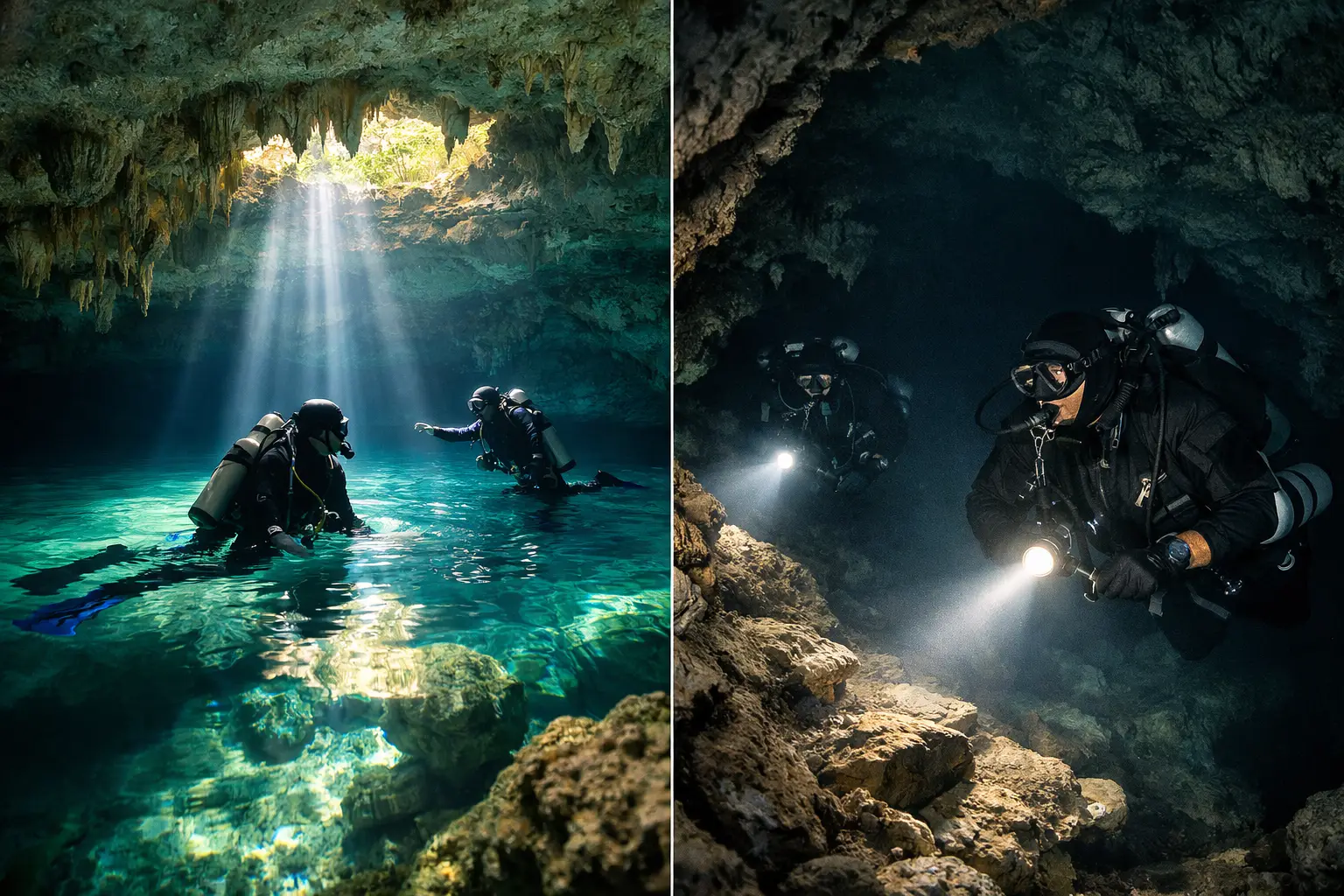
A beam of sunlight cutting through a cenote can make an overhead environment feel open, calm, and almost effortless. That feeling is exactly why cavern diving vs cave diving is a distinction every diver should understand before entering Tulum’s underground world. Both can be extraordinary, but they are not interchangeable experiences, and the training, equipment, planning, and limits behind them are very different.
For travelers, guided cavern diving is often the unforgettable first encounter with the Riviera Maya’s cenotes. For technical divers, cave diving opens the door to a far more demanding discipline built on specialized skills and disciplined decision-making. Knowing which is which is not about taking the mystery out of the experience. It is how you get to enjoy it with confidence.
Cavern Diving vs Cave Diving: The Core Difference
The simplest distinction is daylight. In a cavern, divers remain within the daylight zone, where natural light from the entrance is visible at all times. In a cave, divers travel beyond that zone into areas where there is no direct view of daylight and no immediate access to the surface.
That difference changes everything. A cavern dive still takes place in an overhead environment, meaning you cannot simply ascend directly to the surface if an issue occurs. But the route is planned to stay close to the entrance, follow a continuous guideline, and maintain visible ambient light. It is a carefully managed adventure, not an open-water dive transplanted underground.
Cave diving goes farther. Once the daylight zone disappears, a diver must be able to navigate out using a guideline, manage gas for the exit, solve equipment problems in complete darkness, and maintain control in a confined setting. The cave does not become less beautiful beyond the cavern zone. It becomes less forgiving.
What a Cavern Dive in Tulum Feels Like
Tulum’s cenotes are freshwater sinkholes connected to one of the world’s largest underwater cave systems. On a guided cavern dive, you may descend beneath a limestone ceiling and follow a route through cathedral-like chambers, delicate rock formations, shafts of blue light, and the ghostly shimmer of a halocline where fresh and salt water meet.
The experience can feel otherworldly, yet a professional cavern dive is structured around conservative limits. Your guide chooses the route, monitors the group, and keeps the dive within the daylight zone. A permanent guideline provides a clear reference to the exit, and the pace is intentionally unhurried so you can enjoy the scenery without losing awareness of where you are.
For certified recreational divers, cavern diving can be an accessible way to experience cenotes when conducted with an appropriately qualified guide and within local rules. You do not need to be a full cave diver to join a guided cavern tour. You do need solid buoyancy, calm awareness, respect for the environment, and the willingness to follow the briefing precisely.
That last part matters. Cenote formations took thousands of years to develop. A careless fin kick can disturb fine sediment, reduce visibility, or damage formations that cannot be replaced. Great cavern divers move slowly, stay streamlined, and leave no trace beyond a few bubbles.
Why Cave Diving Requires a Different Mindset
Cave diving is not simply cavern diving with more distance. It is a technical discipline with its own training progression, equipment configuration, emergency procedures, and team protocols.
A trained cave diver learns to treat the guideline as a lifeline. They practice locating and following it with no visibility, conducting gas-sharing exits, handling lost-diver scenarios, placing and removing lines correctly, and making decisions before small problems become serious ones. These skills are built through repetition in controlled conditions, not learned on the day of a vacation dive.
The mental shift is just as important as the technical one. In open water, an uncomfortable moment may be resolved by a direct ascent, provided it is safe to do so. In a cave, the exit is horizontal and may be hundreds or thousands of feet away. The correct response is not to rush. It is to stop, communicate, manage the problem, protect the team, and follow the plan out.
This is why cave training emphasizes discipline over bravado. The strongest cave divers are not the ones who push deepest or fastest. They are the divers who recognize limits, turn a dive early when conditions change, and save the more ambitious route for another day.
Training: Guided Cavern Experience or Cave Certification?
If you are an Open Water diver visiting Tulum, a guided cavern dive may be an excellent next adventure. Before booking, be honest about your recent experience, comfort in the water, equalization ability, and buoyancy control. A trusted dive center will assess whether a particular cenote and route suit your experience level rather than treating every certified diver the same.
If the cenotes inspire you to pursue technical exploration, cave training should be a deliberate progression. Divers typically begin by strengthening foundational skills such as propulsion techniques, trim, buoyancy, emergency gas-sharing, situational awareness, and comfort with redundant equipment. From there, formal overhead-environment training develops in stages, often beginning with cavern or introductory cave-level skills before advancing further.
Requirements and course names vary by training agency, instructor, and local standards. What does not vary is the need for a qualified instructor, sufficient experience, and time to practice. A card alone is not the goal. The goal is becoming the kind of diver who can consistently make sound decisions under pressure.
At Infinity2Diving, the same safety-first philosophy that shapes guided cenote experiences also matters for divers building toward technical and cave training. The right path is personal: some divers come to Tulum for a magical morning in the light zone, while others return ready to commit to a serious new level of education.
Equipment Differences Matter
A guided cavern diver may use familiar recreational equipment, often with additional precautions determined by the site and the dive plan. Good trim, secure hose routing, reliable lights, and careful finning become especially valuable in a silty overhead setting. Your guide will explain the configuration, light signals, route, depth limits, and no-touch rules before entering the water.
Cave divers use more specialized, redundant equipment. Depending on the dive, this may include doubles or sidemount cylinders, multiple independent lights, reels and safety spools, cutting devices, redundant buoyancy, and carefully configured regulators. Every item has a purpose, a place, and a procedure for failure.
More gear does not automatically make a diver safer. In fact, unfamiliar gear can create new problems. A cave configuration only works when the diver has trained extensively with it, can reach and operate every component efficiently, and understands how it supports the team’s gas plan and exit strategy.
Gas Planning Is Not Just About Air Consumption
All divers monitor gas, but overhead diving requires a more conservative approach because the exit may take time. In cave diving, teams commonly apply formal gas-management rules designed to reserve enough breathing gas for a controlled exit, including an emergency where one diver may need to share gas with another.
The exact plan depends on the route, depth, current, restrictions, equipment, team size, and contingency needs. This is one reason cave diving cannot be reduced to a simple depth certification or a confidence test. A diver may be comfortable at 100 feet in open water and still be unprepared for a shallow cave passage with a long swim to daylight.
For guided cavern diving, your guide manages the route and turn points conservatively. Your responsibility is to monitor your own gauges, stay close enough to communicate, and signal early if something does not feel right. Silence is never the goal. Clear communication is.
Choosing the Right Experience for You
Choose a guided cavern dive if you are a certified recreational diver who wants to see the cenotes’ famous light effects and geological beauty while remaining within recreational limits. It is a remarkable experience for divers who are curious, attentive, and ready to follow an experienced local guide.
Choose cave training only if you are drawn to the discipline behind the exploration. You should enjoy skill practice, accept that progress takes time, and be willing to turn down dives that exceed your current training or conditions. The reward is not access to a more extreme version of diving. It is the privilege of exploring places that demand your best judgment.
Whether your next step is a guided swim through sunlit cenote chambers or the first day of a technical training path, let curiosity lead you there and preparation bring you home safely. The underground world of Tulum is powerful precisely because it asks us to slow down, pay attention, and earn every meter of exploration.