A perfect hover is not a trick reserved for experienced divers. It is the moment when you stop fighting the water: your fins stay clear of the reef, your breathing slows, and you can pause beside a cenote wall without touching it. Learning how to improve scuba buoyancy gives you more comfort, more control, and a far more respectful way to explore the underwater world.
Buoyancy is one of the first skills divers learn, but it is also one of the last skills they stop refining. Conditions change. A thicker wetsuit, a new cylinder, salt water, fresh water, or a different BCD can all shift how you float. The good news is that excellent buoyancy is built through calm awareness and repeatable habits, not through strength or oversized fin kicks.
Start With Proper Weighting
Many buoyancy problems begin before you descend. Carry too much weight and you will need to add more air to your BCD to compensate. That creates a larger bubble of air around your body, which expands as you ascend and makes depth control harder. Overweighted divers also tend to kick more, use more air, and descend into the sand or reef before they can react.
A proper weight check should be done with a nearly empty cylinder, not just a full one at the start of the dive. In a safe, controlled setting, hold a normal breath at the surface with an empty BCD. You should float at eye level. When you exhale, you should begin to sink slowly.
This check is a starting point, not a universal formula. A diver in a 3 mm wetsuit in warm Caribbean water may need a very different amount of weight than that same diver in a dry suit. Aluminum tanks become more buoyant as they empty, while steel tanks generally remain more negative. Ask your instructor or guide to help you assess your configuration whenever your gear or environment changes.
How to Improve Scuba Buoyancy Through Breathing
Your lungs are your most precise buoyancy tool. A deep inhale adds a little lift. A longer exhale lets you settle slightly lower. These are small adjustments, but they are powerful once you stop using your BCD for every movement.
The key is to breathe continuously and naturally. Never hold your breath underwater. Instead, slow your breathing and make each inhale and exhale deliberate. If you rise a few inches, exhale gently over several breaths. If you sink, take a slightly fuller breath. Give your body time to respond before making another correction.
New divers often breathe in short, nervous bursts, especially during an exciting descent or while watching marine life. That pattern causes constant movement in the water. A relaxed, steady rhythm helps your buoyancy and conserves air at the same time. Before a dive, take a moment to settle your pace. Underwater, notice whether your breathing becomes shallow when you are task-loaded or excited.
Make Small BCD Adjustments
Your BCD is for broad changes in buoyancy, especially during descent and ascent. It is not an elevator button. Adding or releasing large amounts of air creates a cycle of rising, dumping air, sinking, and inflating again.
Use short, controlled bursts instead. Add only a small amount of air, then wait. Your body may need several seconds to respond, particularly when you are wearing a wetsuit that compresses with depth. If you are descending too fast, pause your descent, orient yourself upright if needed, and add a small amount of air. Do not rush to fix the issue with a big inflation.
When releasing air, make sure the dump valve is at the highest point on your body. Air travels upward, so a valve near your shoulder cannot effectively vent air trapped in the lower part of your BCD if you are horizontal or head-down. A small change in body position can make the difference between a clean release and a frustrating one.
Find a Balanced, Horizontal Trim
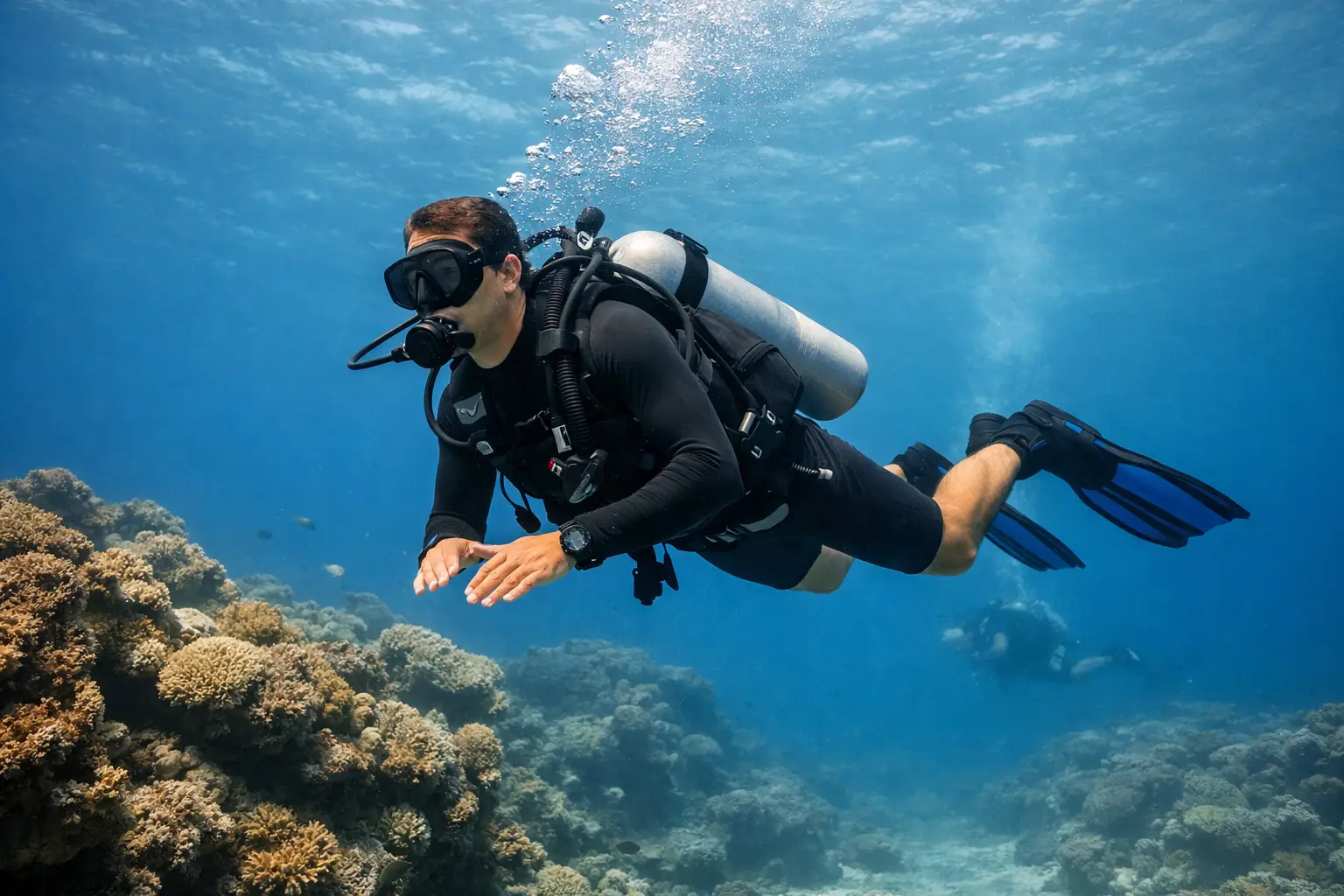
Buoyancy and trim work together. A diver who is upright with legs hanging below them may be neutrally buoyant but still have poor control. A balanced horizontal position reduces drag, protects the bottom, and makes breathing adjustments more effective.
Aim to keep your body long and relaxed, with your knees slightly bent and fins raised behind you. Your head should be in line with your spine, looking forward rather than down. Looking down often drops your legs, which encourages you to kick harder and can send fin wash toward fragile coral or sediment.
If your feet repeatedly float upward, your weight may be positioned too high. If your legs sink, you may need to shift some weight higher or adjust the placement of your cylinder. Small gear changes can have a major effect. Move one element at a time and test it rather than changing everything between dives.
In the clear, still water of a cenote, poor trim becomes obvious quickly. A gentle fin stroke can stir sediment that remains suspended long after you pass. In reef environments, good trim gives you the freedom to observe close-up without making contact. It is a skill that makes every dive look and feel more composed.
Slow Down Your Movements
Quick movements create quick buoyancy changes. Strong finning sends you forward and often slightly upward. Fast arm movements disrupt your balance. Even reaching for a camera or pointing at a turtle can shift your position if you are not aware of your core and breathing.
Practice moving deliberately. Use efficient, unhurried fin strokes, then glide. Keep your hands still unless you are signaling or managing equipment. When you stop, let yourself settle into a hover rather than sculling with your hands.
A useful exercise is to choose a visual reference, such as a rock, a mooring line, or a point on a sandy bottom, and hover nearby without touching anything. Notice what causes you to drift: an inhale, a fin movement, a change in posture, or a current. This kind of focused practice turns buoyancy from an abstract idea into a physical skill you can feel.
Practice at Different Depths
Your wetsuit changes buoyancy as pressure changes. On descent, neoprene compresses and loses buoyancy, so you may need to add a little air to your BCD. On ascent, it expands again, making you more buoyant. This is why a slow ascent and frequent checks are essential.
Do not wait until you are rising quickly to vent air. Anticipate the change. As you begin ascending, look at your depth, maintain an upright or slightly head-up position when needed to vent, and release small amounts of air before the expansion accelerates. Keep breathing slowly and use your fins only to control your direction, not to force yourself downward.
Practice hovering at several depths during appropriate parts of a dive. Can you hold a stop at 15 feet without grabbing a line? Can you stay level while your buddy adjusts a mask or takes a photo? These are real-world buoyancy tests that build confidence far beyond a single pool exercise.
Build Buoyancy Into Every Dive
You do not need to dedicate every dive entirely to drills. Choose one focus for each dive: a slower descent, a more controlled hover, better fin position, or fewer BCD adjustments. Briefly review what worked afterward with your buddy or instructor. Progress comes faster when you can name the habit you are working on.
A guided buoyancy session is especially valuable if you feel stuck. An experienced professional can see details you may not notice, from an uneven weight distribution to an inflator hose position that prevents proper venting. At Infinity2Diving, personalized coaching can help divers turn those small corrections into confident habits for reefs, wrecks, and cenotes.
The goal is not to hold an unrealistically motionless pose. Water moves, currents shift, and every body breathes. The goal is to respond calmly, stay aware of your surroundings, and leave the underwater environment exactly as you found it. Each relaxed hover is proof that you are becoming the kind of diver marine life barely notices – and every dive becomes more rewarding because of it.