
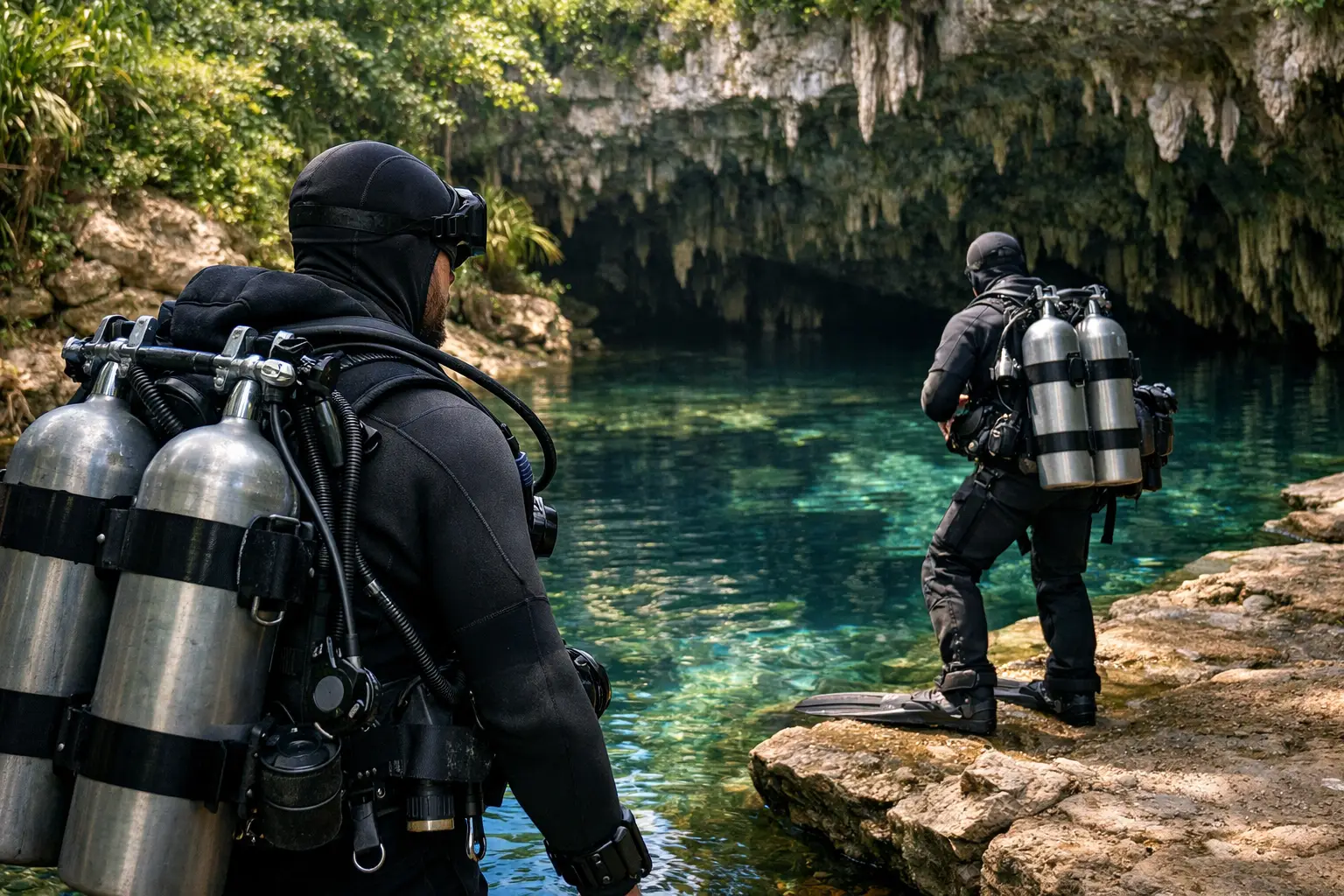
A technical diver does not simply carry more equipment or descend deeper. They learn to plan precisely, manage gas with discipline, solve problems without rushing, and make decisions that protect the whole team. This guide to technical diving courses is for certified divers who feel drawn to longer dives, deeper wrecks, overhead environments, or the calm focus that comes from developing serious underwater capability.
For many divers visiting Tulum, that next step begins with a question: am I ready? The answer is rarely about bravado. Technical training rewards patience, strong fundamental skills, physical readiness, and a genuine respect for limits. It can be one of the most empowering paths in diving, but it should be approached progressively and with the right instructor, conditions, and mindset.
What Makes a Dive Technical?
Technical diving expands beyond the no-decompression limits and direct ascent profile of standard recreational diving. A technical dive may involve planned decompression stops, accelerated decompression gases, deeper depths, twin cylinders, sidemount configurations, closed-circuit rebreathers, or an overhead environment where a direct vertical ascent is not possible.
The equipment matters, but it is not the definition. Technical diving is a system of planning, team communication, buoyancy control, propulsion, gas management, and contingency preparation. You learn to make every part of that system work together before adding greater depth or complexity.
That is why a quality course may feel demanding even in shallow water. Before a student is cleared for more ambitious profiles, an instructor needs to see controlled ascents, stable trim, accurate buoyancy, valve drills, gas switches, emergency responses, and thoughtful decision-making. The goal is not to push limits. The goal is to build the skills to recognize and respect them.
The Technical Diving Course Path
There is no single course that turns a recreational diver into a technical diver overnight. The best path depends on your certifications, logged experience, comfort in the water, and long-term goal. A diver hoping to extend bottom time on deep reefs may follow a different route from someone preparing for cave training.
Start by sharpening your fundamentals
Before beginning formal technical training, many divers benefit from a skills-focused preparation course or dedicated practice time. Excellent buoyancy and trim are not cosmetic achievements. They reduce silt, conserve energy, protect fragile environments, and make task-loading manageable when the dive becomes more complex.
You should be able to hold depth steadily, hover without sculling, deploy an SMB with control, maintain awareness of your buddy, and respond calmly when a drill interrupts the plan. If these skills are still developing, spending time on them first is a smart investment, not a delay.
Introductory technical and sidemount training
An introductory technical course is often the first formal step. It introduces technical equipment configurations, team protocols, gas planning concepts, and the disciplined problem-solving approach behind advanced diving. Depending on the training agency and course structure, it may be conducted within recreational depth limits while building the foundation for decompression diving.
Sidemount training is another valuable route, especially in the Riviera Maya. With cylinders worn at the diver’s sides rather than on the back, sidemount can offer streamlining, redundancy, and practical access to valves. It is widely used in cave environments, although sidemount itself is not a cave certification. It is a configuration that must be learned and maintained correctly.
Decompression procedures and extended range
Once core technical skills are consistent, decompression training teaches divers how to plan and execute dives that require mandatory stops before surfacing. You will learn to use additional cylinders, manage staged gases, calculate contingencies, and maintain control throughout a longer ascent.
Extended-range training may take that knowledge deeper, allowing appropriately certified divers to conduct planned decompression dives beyond recreational limits. Exact depth limits, prerequisites, and gas options vary by agency and program. What matters is that your training matches the dives you intend to make, rather than collecting certifications for their own sake.
Cave training requires its own progression
Tulum’s cenotes are extraordinary, but their beauty should never blur the distinction between cavern diving and cave diving. A cavern zone remains within daylight and near an exit. A cave environment extends beyond that zone and introduces overhead restrictions, navigation demands, line protocols, and a much smaller margin for error.
Cave training is a separate, deliberate progression. It typically begins with foundational overhead and line skills before moving toward more advanced cave environments. Divers need exceptional buoyancy, finning, awareness, gas discipline, and emotional control. The right course will not promise quick access to advanced cave dives. It will ask you to earn each step.
Prerequisites: Are You Ready to Begin?
Course prerequisites differ, so confirm the specific standards with your instructor before booking. In general, technical programs expect an Advanced Open Water-level foundation or equivalent, recent diving experience, a defined number of logged dives, and comfort with basic navigation, emergency procedures, and buoyancy control. Some programs also require enriched air certification and evidence of experience using it.
Fitness matters too. Technical diving can involve heavier equipment, longer days, repeated drills, and conditions that require stamina. You do not need to be an elite athlete, but you should be medically fit to dive and honest about your energy, hydration, and stress level. A current medical evaluation is especially wise if you have any health concern or have been away from diving for a long time.
Readiness also includes attitude. Technical students need to welcome feedback, repeat skills until they are reliable, and call a dive when conditions or performance are not right. The strongest divers are not the ones who never encounter difficulty. They are the ones who identify it early and respond without ego.
How to Choose a Technical Diving Course
When comparing courses, look beyond the course title and advertised maximum depth. Ask how many days are included, how much water time you will receive, whether equipment is included, how student-to-instructor ratios are managed, and what happens if a skill needs more practice. Technical training should never feel rushed to fit a vacation schedule.
Instructor experience deserves close attention. Look for an instructor who actively teaches at the level you seek, understands the local environment, and can explain not just what to do, but why the procedure exists. A great instructor creates high standards without creating unnecessary pressure. You should leave each day challenged, informed, and clear about what to improve.
Also consider where the training happens. Tulum offers warm water, dramatic cenotes, and access to varied environments that can support focused skill development. Yet ideal conditions do not replace discipline. Clear water can make early practice more comfortable, while the overhead setting of cenotes makes careful training and conservative choices even more essential.
At Infinity2Diving, technical and cave pathways are approached as a progression, with experienced guidance, safety-led planning, and respect for the unique underground world of the Riviera Maya. The point is not to rush toward a deeper number. It is to become the diver who can meet each new challenge with composure.
Gear Is Part of the System
Technical diving equipment is configured for redundancy, streamlining, accessibility, and problem solving. Depending on the course, that may include a twinset or sidemount cylinders, a long-hose regulator setup, backup lights, a wing and harness system, cutting devices, reels or spools, an SMB, and additional decompression cylinders.
Do not buy everything before speaking with your instructor. Different programs and environments favor different configurations, and proper fit is critical. Renting course-specific equipment can be a sensible choice for an initial program. As your direction becomes clear, purchasing gear that fits your body, training path, and expected diving is usually better than choosing equipment based on appearance or trends.
Technical equipment also requires care. Assembly checks, hose routing, labeling, gas analysis, and maintenance are part of the discipline. The most sophisticated setup in the world is only useful when you understand every component and can operate it under stress.
What You Will Take Home From Training
The real outcome of technical training is not a card in your wallet. It is a more deliberate way of diving. You begin to plan with greater precision, communicate more clearly, notice small changes earlier, and understand how one decision affects the entire dive.
That confidence can enrich recreational diving too. A controlled hover on a reef, a calm response to a minor equipment issue, or a better grasp of gas management makes every dive more enjoyable for you and your buddy. Technical education often changes how divers see the underwater world because it replaces casual assumptions with earned awareness.
Choose the course that fits the diver you are now, then give yourself room to grow. The cenotes, reefs, and deep blue water will still be there. Your job is to arrive at the next threshold prepared, curious, and fully present for the adventure.