
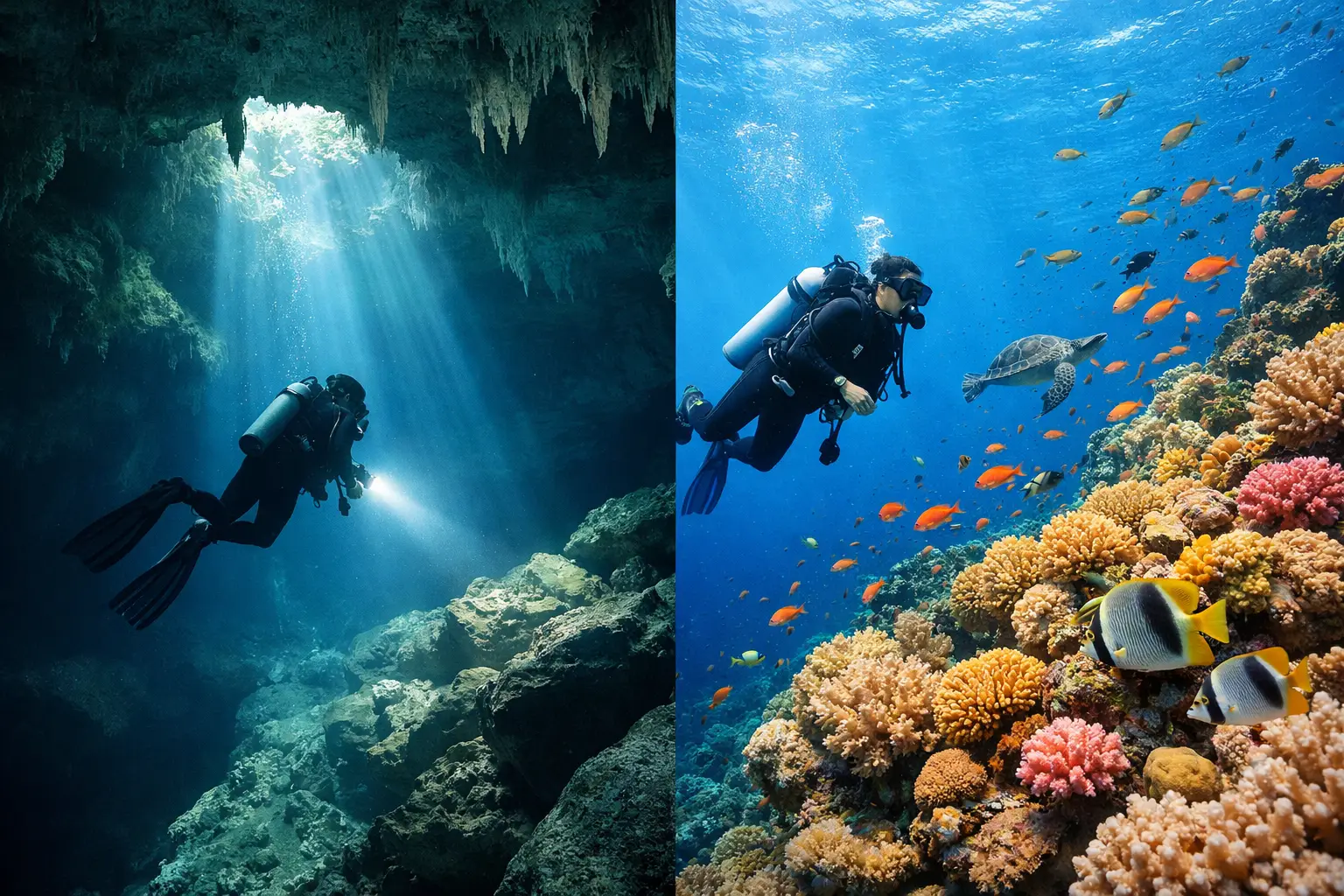
A reef drifts with the current, flashes with color, and hums with life. A cenote can feel almost silent: sunbeams cut through clear freshwater, limestone walls close in, and the jungle disappears above you. When travelers ask about cenote diving vs reef diving in Tulum, they are not choosing between a better and worse dive. They are choosing between two completely different kinds of wonder.
The Riviera Maya is one of the rare places where you can experience both during the same trip. One day may bring turtles, schools of tropical fish, and easy blue-water descent lines. The next may take you beneath the Yucatan jungle into a freshwater cavern shaped over thousands of years. The best choice depends on your certification, comfort level, conditions, and what you want to feel underwater.
Cenote diving vs reef diving: the real difference
Reef diving is open-water diving along the Caribbean coast. You descend into saltwater, follow a reef or sandy bottom, and have open water above you throughout the dive. The experience is defined by movement, marine life, changing light, and the rhythm of the sea.
Cenote diving takes place in freshwater sinkholes connected to the vast underground cave systems of the Yucatan Peninsula. Most guided recreational cenote trips explore the cavern zone, where daylight remains visible and divers stay within established routes. It is not the same as full cave diving, which requires specialized training, equipment, and procedures.
That distinction matters. A cenote is breathtaking, but it is a more controlled and technically aware environment than an easy reef cruise. Your guide will manage the route, depth, group positioning, and environmental rules carefully. For qualified divers who are ready to listen, move calmly, and respect the setting, it can become one of the most unforgettable dives of a lifetime.
What reef diving feels like in Tulum
Reef diving is alive with possibility. On a typical Caribbean dive, you may see parrotfish working over coral, angelfish hovering near sponges, barracuda in the blue, rays crossing the sand, or a turtle passing with no interest in your schedule. Every dive changes with the season, weather, current, and the simple luck of being in the right place at the right moment.
The physical feeling is also different. Saltwater makes you more buoyant, while currents may ask you to refine your trim, breathing, and finning. Some days are gentle and relaxed. Others bring surge, wind, or current that makes the dive more active. That variability is part of the attraction, especially for divers who love ocean energy.
Reef diving is often the stronger choice for travelers who want classic tropical scuba: colorful fish, expansive blue water, sunlight on coral, and the chance to encounter larger marine life. It is also an excellent setting for building foundational confidence after certification. You practice buoyancy in a natural environment while enjoying a dive that feels spacious and social.
Marine life is the main event
If your dream dive includes turtles, eagle rays, nurse sharks, schools of fish, and vivid reef scenes, choose the ocean. Cenotes have their own life, including small freshwater fish and occasional turtles, but wildlife is not the reason most divers go. The geology is.
Reefs also connect directly to conservation. Good buoyancy, awareness of your fins, and responsible guiding protect fragile coral and marine habitats. A great reef dive should leave you inspired by the ocean, not merely entertained by it.
What cenote diving feels like
Cenote diving is about atmosphere. The visibility can be extraordinary, often making the limestone formations appear close enough to touch even when they are much farther away. Roots reach down from the jungle, stalactites hang overhead, and beams of sunlight pour through openings in the rock during the right time of day.
Then there is the halocline. In some cenotes, freshwater meets denser saltwater below, creating a shimmering visual layer that can look like heat rising off pavement. Passing through it can distort the view around you for a moment. It is strange, beautiful, and unlike anything on a reef.
The water temperature is usually cooler and more stable than the Caribbean. Many divers appreciate the calm conditions and lack of current, but cenotes demand precision in a different way. You need to maintain excellent buoyancy, stay close to your guide, avoid touching delicate formations, and remain aware of your position within the cavern route.
The setting rewards calm divers
A cenote is not a place to rush, chase wildlife, or test how close you can get to a rock ceiling. The experience becomes powerful when you slow down. Controlled breathing, relaxed finning, and careful observation reveal the scale of the space around you.
For many certified divers, this is the first time scuba feels truly otherworldly. It is not just underwater sightseeing. It is a journey through ancient geology and a landscape that exists only because the Yucatan limestone holds one of the world’s largest submerged cave systems.
Which dive is better for your experience level?
For newly certified divers, reef diving is often the more familiar place to begin. There is open water above, visual references are easy to understand, and the environment helps you settle into the rhythm of diving. If it has been a while since your last dive, a refresher and a relaxed reef dive can rebuild confidence before adding a cenote day.
That said, many Open Water Divers can enjoy a guided cavern cenote experience when conditions, comfort, and local requirements align. The key is honesty. If you feel anxious in confined spaces, struggle to control buoyancy, or have not dived recently, tell your dive professional before booking. The right team can recommend a suitable route, arrange a refresher, or suggest starting on the reef.
Experienced divers often love combining both. Reef diving delivers the big, living Caribbean picture; cenote diving delivers stillness, structure, and visual drama. Neither replaces the other.
For technical and cave-trained divers, the conversation changes again. Full cave diving is a specialized discipline with dedicated training, redundant equipment, gas planning, navigation protocols, and strict limits. Recreational cavern diving is not a shortcut into cave diving. Respect for the difference is part of being a capable diver.
Conditions, comfort, and practical trade-offs
The ocean is influenced by weather. Wind, waves, surface conditions, and currents can affect the plan, even when underwater visibility remains good. A professional dive center will choose sites carefully and adjust for safety rather than force a schedule.
Cenotes are more sheltered from surface weather and usually offer consistently calm water. That makes them appealing when the sea is rough, but the stable conditions do not make them casual. Their overhead environment requires disciplined guiding and careful diver behavior.
There are practical differences in preparation too. Reef days usually mean boat travel, exposure to sun, and saltwater. Cenote days often include driving inland, gearing up in the jungle, and entering cooler freshwater. A wetsuit that feels perfect in the ocean may feel light in a cenote, so ask your team what thermal protection is appropriate.
Photography also changes. Reef photographers can chase color, motion, and wide blue-water scenes. Cenote photographers work with contrast, light rays, silhouettes, and formations. Both are beautiful, but cenotes require extra awareness: a camera should never distract you from buoyancy, your guide, or the route.
How to choose your Tulum dive plan
If you have only one diving day, choose based on the memory you want to bring home. Choose the reef if you want marine life, Caribbean color, and the freedom of open water. Choose a cenote if you want dramatic light, crystal-clear freshwater, and a quieter, more immersive setting.
If you have two or more days, do both. Start with the reef if you are getting comfortable again, then step into a cenote once you feel settled in your equipment and buoyancy. Or begin with a cenote when ocean conditions are less favorable and save the reef for a calmer day.
At Infinity2Diving, the goal is never to push you into a dive that does not fit. It is to match the experience to your certification, confidence, and sense of adventure, with expert guidance from briefing to exit.
Bring your questions, your curiosity, and a willingness to be surprised. The Caribbean reef may remind you how alive the ocean is. A cenote may show you just how much of the world still waits beneath the surface.