
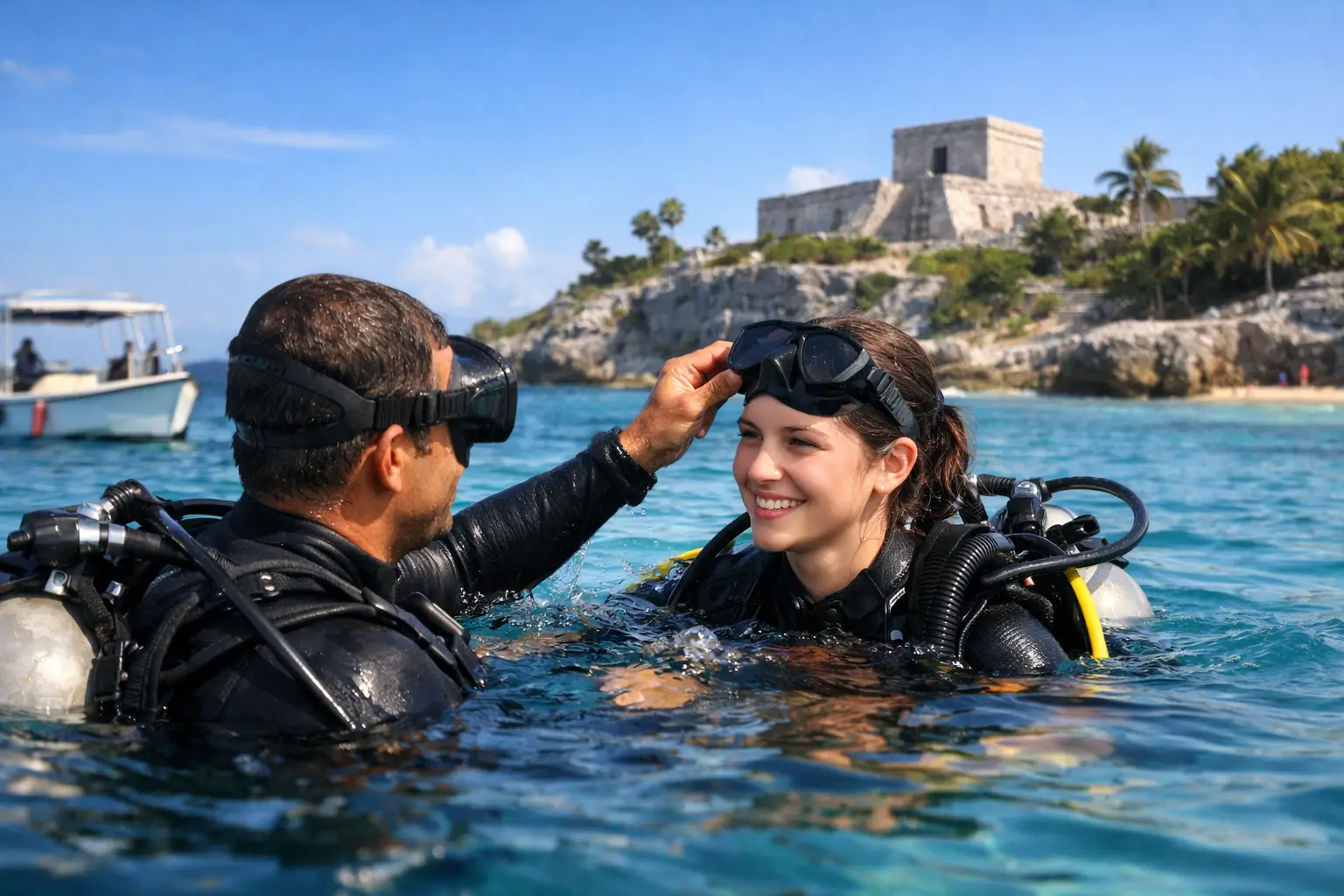
The moment you take your first real breath underwater, Tulum changes. The coast becomes more than white sand and turquoise water. It becomes a gateway to coral gardens, quiet Caribbean walls, and the extraordinary freshwater cenotes hidden in the jungle. A Tulum scuba certification gives you the skills and confidence to experience all of it safely, with a credential you can use around the world.
For first-time divers, certification is not about proving you are fearless. It is about learning a few essential skills well, being supported by an instructor who notices the details, and discovering that the underwater world can feel both thrilling and remarkably calm.
Why Earn Your Tulum Scuba Certification?
Tulum is one of the rare destinations where training can feel like a real adventure rather than time spent in a classroom. You may begin by practicing core skills in confined water, then progress to open-water dives in the Caribbean. Once certified and ready for the experience, the Riviera Maya also offers access to cenotes, where clear freshwater, dramatic rock formations, and beams of sunlight create a completely different kind of dive.
That variety matters. A good course should teach you how to plan and make safe recreational dives anywhere, not simply guide you through a checklist. Learning in Tulum lets you connect those skills to a destination you came to explore.
There is also a practical reason to get certified while traveling. Instead of spending your vacation watching other divers head out by boat, you can build a qualification that opens future trips in Mexico, the Florida Keys, Indonesia, the Red Sea, and beyond. PADI Open Water Diver certification is recognized internationally, giving you a strong foundation for a lifetime of diving.
What the PADI Open Water Course Includes
The PADI Open Water Diver course is designed for people with no prior scuba experience. You do not need to be an elite swimmer or arrive knowing how equipment works. You do need to be comfortable in the water, able to meet the course’s swimming and floating requirements, and willing to learn at a steady pace.
Training usually has three parts: knowledge development, confined-water practice, and open-water dives. The knowledge portion covers the principles behind safe diving, including pressure, buoyancy, equipment, planning, communication, and protecting the underwater environment. Depending on your schedule, some academic work can be completed before you arrive, leaving more of your Tulum time for the water.
Confined-water sessions are where new divers turn information into muscle memory. You will practice clearing water from your mask, recovering a regulator, controlling your buoyancy, sharing air in an emergency simulation, and responding calmly to common situations. These skills may sound technical on land. In the water, under patient guidance, they become manageable and empowering.
The open-water dives bring everything together. This is where you apply what you have practiced while exploring a real underwater setting. Your instructor evaluates your skills, but the goal is never to rush you through. The goal is to help you become a capable, aware dive buddy who can enjoy the experience without losing sight of safety.
How Long Does Certification Take in Tulum?
Most travelers complete an Open Water Diver course in three to four days. The exact pace depends on how much theory you complete in advance, weather conditions, your comfort in the water, and the training schedule. If you are trying to squeeze certification between a late arrival and an early flight home, a shorter itinerary may feel stressful. Giving yourself breathing room makes the experience far more enjoyable.
If your vacation is limited, ask about starting the academic portion at home or completing part of the course near home before finishing your open-water dives in Tulum. This referral-style approach can work well, but it does involve coordinating records and requirements between dive centers. For many travelers, completing the entire course with one instructor and one team is the simpler choice.
Do not plan your final dive for the day before you fly. Divers need to allow an appropriate surface interval before flying after scuba diving. Your dive center will advise you based on your dive profile, but building in at least a full day after your last dives is the smart way to protect both your schedule and your safety.
Reef Training, Cenotes, and the Right First Experience
Tulum’s Caribbean reefs are a natural fit for open-water training. Warm water, colorful marine life, and gentle conditions can make those first descents feel welcoming. You might see schools of tropical fish, sea turtles, rays, and coral formations while learning to hover, manage your air, and move as part of a buddy team.
Cenotes are equally unforgettable, but they require a little more context. A certified Open Water Diver can enjoy certain cenote experiences with an appropriate guide when conditions and training level allow. However, overhead environments and cave diving are specialized disciplines. Full cave training is not part of an entry-level course, and a responsible dive center will never blur that line.
This is one of the best reasons to choose instruction over a quick, bargain-focused experience. The right team will celebrate your excitement while being honest about what you are ready to do today and what can become a future goal. There is no need to rush the progression. Every new skill expands what is possible.
Choosing a Dive Center You Can Trust
Your first certification sets the tone for every dive that follows. Look beyond the price tag and ask how the center runs its courses. Are groups kept manageable? Is equipment well maintained and correctly fitted? Will you train with a qualified PADI instructor from start to finish? Does the team explain the plan clearly and make room for questions?
All-inclusive pricing can make a meaningful difference, especially for travelers. You should understand what is included before you commit: learning materials, rental gear, pool or confined-water sessions, boat or transportation arrangements, certification fees, and any entrance fees relevant to the training sites. A clear package lets you focus on learning rather than unexpected add-ons.
At Infinity2Diving, students train with a female-led team that combines high-level PADI education with the warmth of a local dive family. As Tulum’s only PADI 5 Star Career Development Center, the team can support your first certification and, if diving becomes more than a vacation memory, guide you through advanced and professional pathways too.
What to Bring and How to Prepare
Bring a swimsuit, towel, reef-safe sun protection for time on the surface, and a sense of curiosity. Most students use the dive center’s included equipment during the course. If you already own a properly fitting mask, it can be nice to bring it, but it is not required.
The best preparation is not complicated. Get a good night’s sleep, hydrate well, avoid heavy alcohol before training, and arrive ready to communicate honestly about your comfort level. If a skill feels challenging, say so. Great instructors expect questions and adapt their coaching. Confidence in diving is built through repetition and understanding, not pretending you are comfortable when you are not.
You will also complete medical screening paperwork. Certain health conditions, medications, or recent medical events may require clearance from a physician before you can dive. This is not red tape. It is a safety step that protects you and your instructor, so answer every question accurately and early in the process.
Your Certification Is the Beginning, Not the Finish
After Open Water certification, you can continue building experience through guided reef dives, specialty courses, buoyancy practice, and the PADI Advanced Open Water Diver course. If cenotes have captured your imagination, further training and guided experiences can introduce you to the unique techniques and awareness needed for this environment. If you fall in love with the ocean, conservation-focused activities can turn that feeling into action.
The most memorable divers are not necessarily the ones who collect certifications fastest. They are the ones who stay curious, respect their limits, care for the places they visit, and keep learning from every dive buddy, instructor, reef, and cenote.
Tulum can be where you check scuba diving off a bucket list. Or it can be where you discover a new way to travel, grow, and feel at home in the blue. Give yourself the time, instruction, and support to start it right.