
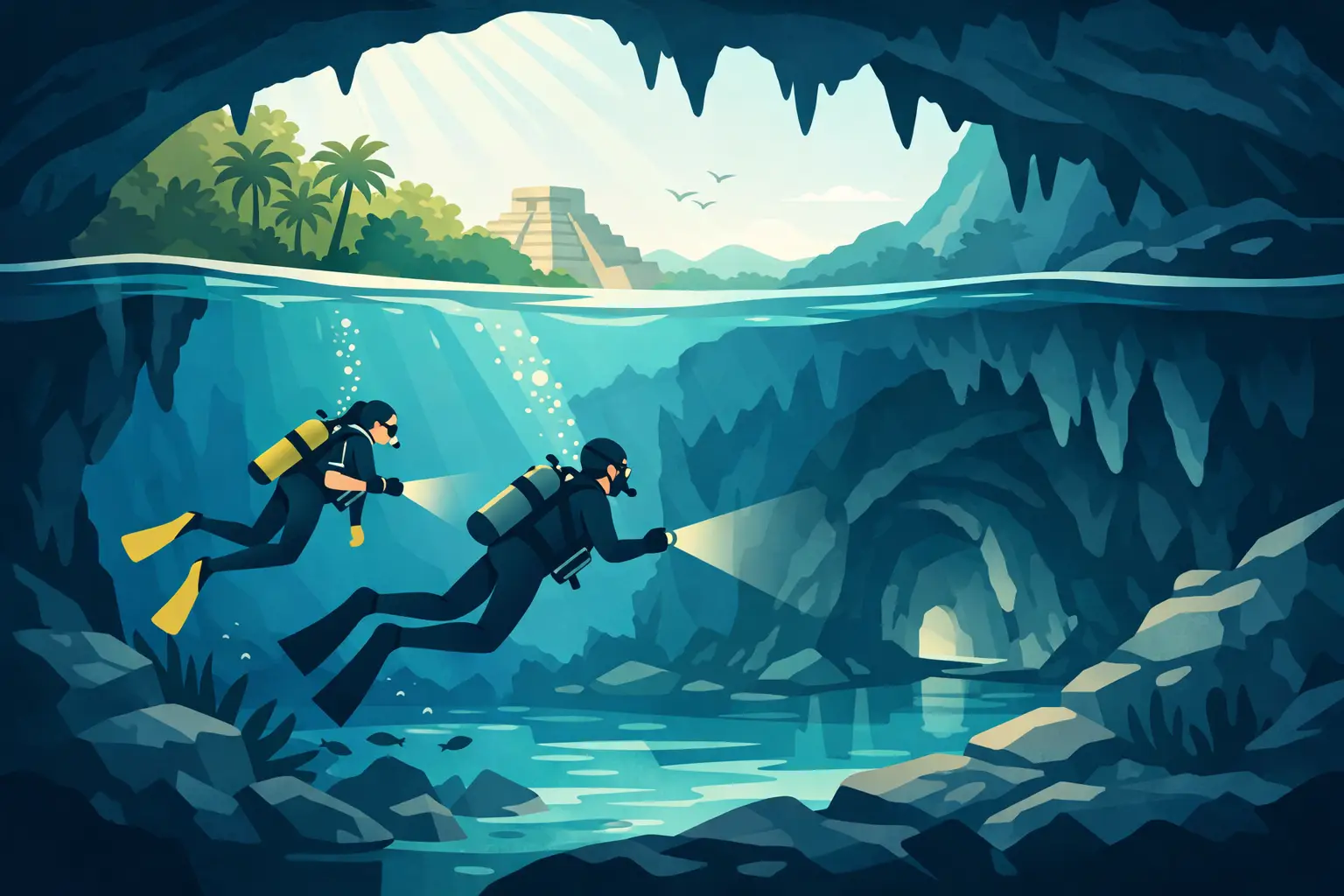
The first time you drop beneath the jungle and watch daylight pour through a cenote ceiling, the usual idea of scuba changes fast. A cavern diving course Mexico experience is not just another specialty card for your logbook. It is a shift in precision, awareness, and respect for an environment that is as beautiful as it is unforgiving.
For divers coming to Tulum, that matters. Mexico offers some of the most striking cavern training conditions in the world, but the setting can create a false sense of ease. Clear water and dramatic light do not make overhead environments casual. Good training does. If you are thinking about taking this step, you want to know what the course really involves, who it is for, and how to choose a program that leaves you more capable, not just certified.
Why take a cavern diving course in Mexico?
There are a few places in the world where cavern training feels like a natural next step, and the Riviera Maya is one of them. The cenotes around Tulum combine visibility, stable conditions, and direct exposure to line work, navigation awareness, buoyancy discipline, and team communication in a setting that rewards calm, controlled diving.
That does not mean every diver should sign up the moment they arrive. A cavern course is best for certified divers who are already comfortable with buoyancy, trim, and situational awareness in open water. If you are still working hard to maintain depth or control your position without using your hands, the smarter move is to build those fundamentals first. Cavern diving asks for accuracy, not improvisation.
The advantage of training in Mexico is that the environment gives you immediate feedback. If your finning stirs silt, you see the impact. If your trim is off, it becomes obvious. If your awareness is narrow, the overhead setting shows you why that is a problem. In strong instruction, those lessons are not intimidating. They are transformative.
What a cavern diving course Mexico program usually includes
Most cavern courses are structured around both academic learning and in-water skill development. The exact sequence depends on the agency and instructor, but the core goals are consistent. You learn how cavern environments differ from open water, how to dive within the daylight zone, how to follow and respect continuous guideline protocols, and how to manage gas with real discipline.
You should also expect a strong focus on equipment configuration. Streamlining is not a style choice in overhead training. It affects safety, mobility, and task loading. A good instructor will look closely at your setup, including hose routing, clipping points, accessories, and whether anything on your kit creates unnecessary drag or entanglement risk.
In the water, the course typically builds around propulsion techniques, trim, buoyancy, communication, emergency procedures, and line awareness. Some divers are surprised by how much of cavern training feels foundational rather than exotic. That is actually a good sign. The point is not to rush toward complexity. The point is to create habits that hold up when the environment becomes less forgiving.
Skills that matter more than people expect
Buoyancy is the obvious one, but it is only part of the picture. Finning technique often becomes a major focus because cavern environments demand control without disturbing the bottom or ceiling. Team positioning matters more than many recreational divers realize. So does pace. Fast is rarely better underground.
Mental bandwidth is another big factor. Can you hold depth, monitor gas, follow the line, stay aware of your teammate, and respond to briefed procedures without becoming overloaded? Cavern training starts to answer that honestly. For some divers, it confirms they are ready for more. For others, it highlights areas that need work first. Both outcomes are valuable.
Who should take this course, and who should wait
A cavern course can be an incredible next step for an experienced recreational diver who wants more challenge, sharper skills, and a serious introduction to overhead diving. It also makes sense for divers already interested in technical or cave pathways, because it builds the discipline those routes demand.
But there is a difference between being excited and being prepared. If you have only a handful of dives, or you still feel inconsistent in your control, there is no downside to waiting. In fact, waiting can make your cavern course far more rewarding. Advanced buoyancy practice, peak performance work, sidemount familiarization in some cases, or simply more logged dives in different environments can all set you up for a stronger experience.
A quality dive center will tell you that plainly. Premium training is not about squeezing every diver into the same track. It is about meeting you at the right stage and helping you progress with confidence.
Choosing the right cavern diving course in Mexico
Not all cavern training is created equal, and this is one area where your choice of instructor matters enormously. You are looking for more than a certification outcome. You are looking for standards, judgment, and teaching that is specific, patient, and uncompromising where it needs to be.
Ask how the course is taught, not just how long it lasts. Small ratios matter. Clear standards matter. So does honesty about whether a diver is ready to pass. In overhead training, an easy sign-off is not a benefit.
You should also look at whether the operation treats the experience as a serious training program or as a quick add-on for tourists. Mexico is full of unforgettable diving, and Tulum has no shortage of visitors chasing adventure. The best centers know how to keep that energy high while still protecting the integrity of the course. That balance is part of what separates a memorable trip from meaningful development.
For divers training in Tulum, working with an established center such as Infinity2Diving can make a real difference because the experience is shaped by local cenote knowledge, professional instruction, and a training-first approach rather than a volume-first model.
Questions worth asking before you book
Ask what prerequisites are required, what gear is included or recommended, how many training dives are involved, and how the instructor handles students who need more time. Also ask where the dives typically take place. Different cenotes present different learning conditions, and site selection should reflect the goals of the day rather than a marketing checklist.
If an operation makes overhead training sound easy, glamorous, or effortless, that is your cue to keep looking. The best cavern courses are exciting, yes, but they are also disciplined and deeply respectful of the environment.
Why Tulum stands out for cavern training
Tulum is not just a beautiful place to dive. It is one of the most distinctive classrooms a diver can enter. The cenotes offer visual drama, but they also support focused skill work because conditions are often more stable than in the ocean. That allows instructors and students to concentrate on precision.
There is also something motivating about learning in a place that feels completely different from standard recreational diving. Haloclines, light beams, fossil formations, and jungle-framed entrances create a strong sense of occasion. For many divers, that emotional impact becomes part of why the training sticks. You remember the lesson because you remember exactly where and how you learned it.
Still, beauty should never distract from context. Caverns are overhead environments. The daylight zone has limits. A course teaches you to operate within those limits confidently and responsibly, not to ignore them.
The gear, mindset, and safety piece
You do not need to arrive as a gear expert, but you should expect your relationship with equipment to become more deliberate. Clean configuration, reliable redundancy where appropriate, proper exposure protection, and comfort with your system all matter. The course may introduce you to setup adjustments that improve efficiency and reduce clutter.
Just as important is mindset. Good cavern divers are not the ones trying to look bold. They are the ones who stay calm, communicate clearly, and respect procedures even when the water is crystal clear and the dive feels easy. That discipline is part of what makes the experience so satisfying. You are not just seeing a new environment. You are becoming a more capable diver inside it.
And that capability carries forward. Even if you never continue into full cave training, cavern education often sharpens every other kind of diving you do. Buoyancy improves. Awareness improves. Teamwork improves. The standard you hold yourself to gets higher.
If Mexico is already on your travel list and cavern diving is on your mind, this course can be one of the most rewarding investments you make in your diving life. Choose the right instructor, arrive ready to learn, and let the cenotes show you how much better your diving can become.