
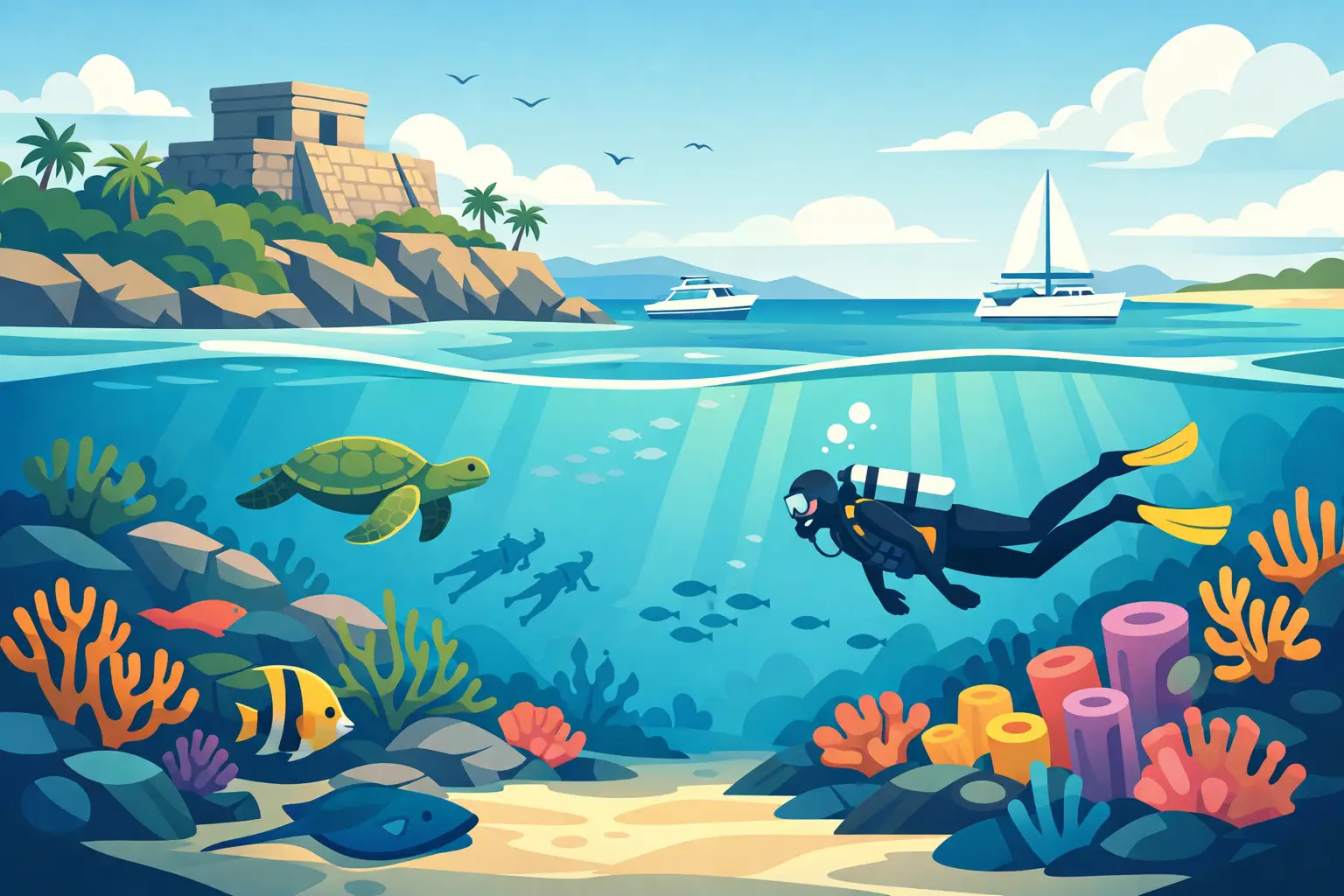
The first thing many divers notice off Tulum is the color shift. One moment the Caribbean is bright turquoise from the boat, and the next you are descending onto coral heads, sandy channels, and schools of fish moving through clear blue water. Reef diving in Tulum Mexico has that rare mix of easy beauty and real substance – it can be relaxed enough for newer divers, but still rewarding for experienced divers who care about marine life, conditions, and smart dive planning.
What makes this part of the Riviera Maya special is not that it tries to be the biggest or the wildest reef destination in the world. It is that diving here fits naturally into a bigger underwater journey. You can spend one day on shallow reef, another in a cenote, and another building skills through advanced training. For travelers who want more than a one-off excursion, Tulum gives you a full diving experience rather than a single headline dive.
Why reef diving in Tulum Mexico stands out
Tulum sits along the Mesoamerican Reef system, the second-largest barrier reef in the world. That matters because you are not diving a small isolated patch of coral. You are entering a living, connected reef environment that supports reef fish, turtles, rays, sponges, soft corals, and seasonal pelagic visitors.
The local reef diving experience is often defined by variety rather than extreme depth or technical challenge. Many sites feature gentle profiles, moderate currents, and visibility that can be excellent on the right day. That makes the area appealing to certified divers who want enjoyable ocean dives without committing to highly demanding conditions every time they gear up.
There is also a practical advantage. Tulum attracts travelers who care about nature, personal growth, and meaningful experiences, so reef dives often pair well with certification courses, refresher sessions, or multi-day dive plans. If you are a little rusty, this is the kind of destination where you can rebuild confidence quickly with professional support.
What the reef is actually like underwater
If you have never dived this coastline, expect a landscape of coral formations, sea fans, barrels sponges, small ledges, and open sandy sections where marine life moves in and out of view. The reef here is not one continuous wall of dramatic drop-offs. Instead, many dive sites are made up of sections and textures that keep the dive interesting from start to finish.
You may find angelfish, parrotfish, trumpetfish, sergeant majors, grunts, and schools of snapper almost immediately. Green morays and spotted eels can appear tucked into crevices, while lobsters and crabs hide under coral shelves. On many dives, sea turtles are the stars. Eagle rays can also pass through, especially in the right season, and nurse sharks are always a possibility depending on conditions and site selection.
That said, marine life is never guaranteed, and any honest dive center should say that clearly. Some days the visibility is stunning and the reef feels alive in every direction. Other days the sea can be choppier, currents stronger, or fish life more spread out. The beauty of Tulum reef diving is consistency over time, not a promise that every single dive will deliver the same spectacle.
Conditions and the best time to go
Conditions in Tulum can be excellent for much of the year, but this is not a place where one answer fits every diver. Water temperature generally stays warm enough for comfortable diving, often with a 3mm wetsuit being enough for many people, though some divers prefer a bit more protection in winter or on repetitive dive days.
Visibility can range from good to beautiful, especially when weather patterns are stable. Wind and swell play a major role on the coast, so ocean conditions can change faster than many visitors expect. If there has been strong wind or rough surface weather, the reef may be less ideal than a cenote day.
Summer often brings warm water and good marine activity, while winter can offer pleasant conditions with occasional fronts that affect boat departures or surface chop. During hurricane season, flexibility matters. The right operator will be honest about whether reef diving is the best choice on a given day or whether another environment is the smarter option.
Is reef diving in Tulum Mexico good for beginners?
Yes, often very much so – with the right site and the right supervision. Many reef dives near Tulum are suitable for newly certified divers because depths are manageable and profiles can be straightforward. If you recently completed Open Water or have limited ocean experience, reef diving can be a great way to practice buoyancy, air consumption, navigation awareness, and comfort in saltwater conditions.
The key phrase is with the right site. Not every day is ideal for every diver. A beginner may do well on a calm morning with mild current and easy entry, but struggle on a day with surface surge or reduced visibility. That is why a quality dive center will ask about your certification, recent dives, confidence level, and goals instead of treating everyone the same.
For uncertified travelers, a discover scuba experience may be possible depending on the operator and sea conditions. For certified divers who feel rusty, a refresher before heading to the reef is often the smartest move. Confidence underwater is not about ego. It is about enjoying the dive safely and having enough mental space to actually notice the reef around you.
What experienced divers will appreciate
Advanced divers sometimes underestimate Tulum reef diving because the region is so famous for cenotes. That would be a mistake. Reef dives here may not always be deep or technical, but they reward divers who pay attention to small details, fish behavior, current lines, and macro life hiding in plain sight.
There is also value in using local reef dives for training progression. Peak performance buoyancy, drift techniques, fish identification, navigation, and advanced open water adventures all make sense in this environment. If you are planning a dive-heavy trip, mixing reef dives with cenotes, wrecks, or continuing education creates a stronger overall experience than chasing one type of diving only.
For divers on a professional path, the reef is also where good habits become automatic. Controlled descents, group awareness, environmental respect, and calm adaptation to changing ocean conditions are skills that matter at every level.
Choosing the right dive center matters more than many travelers think
On paper, a reef dive can look simple. In reality, the quality of the operation shapes almost everything about your day. Briefings, equipment setup, group ratios, marine life etiquette, and site choice all affect whether your dive feels rushed and generic or safe, smooth, and genuinely memorable.
Look for a team that is clear about inclusions, honest about conditions, and serious about diver matching. If one diver wants a relaxed scenic dive and another wants a training-focused experience, those goals should be acknowledged from the start. A premium center should also care about conservation practices, because healthy reef diving depends on protecting the ecosystem rather than treating it as a backdrop.
That is one reason many travelers prefer to book with a center that can support both excursions and education. A team like Infinity2Diving can guide a fun reef morning while also helping divers move into PADI training, advanced specialties, or longer-term development if the trip sparks something bigger.
How to prepare for a better reef dive day
A little preparation changes a lot. If you are prone to seasickness, plan ahead rather than hoping for the best. Hydrate well, sleep properly, and avoid heavy drinking the night before. Ocean diving rewards people who show up rested and comfortable.
If you have your own mask and dive computer, bring them. Familiar gear can reduce stress and improve the dive immediately. If you are renting equipment, arrive with enough time to get the fit right and ask questions.
Most importantly, come ready to listen. Good divers are not the ones who act fearless. They are the ones who pay attention to the briefing, stay aware of the group, protect the reef with solid buoyancy, and know when to communicate honestly if something feels off.
More than a vacation dive
The best reef dives in Tulum do more than fill your camera roll. They remind you that ocean diving can be both exciting and grounding at the same time. You are close enough to shore for it to feel accessible, yet far enough below the surface to step out of the noise completely.
That is why so many travelers come for one reef dive and leave thinking about their next course, their next trip, or a bigger goal they had not named before. If you approach reef diving in Tulum Mexico with curiosity, realistic expectations, and the right team behind you, it can become the kind of experience that stays with you long after the tan fades.