
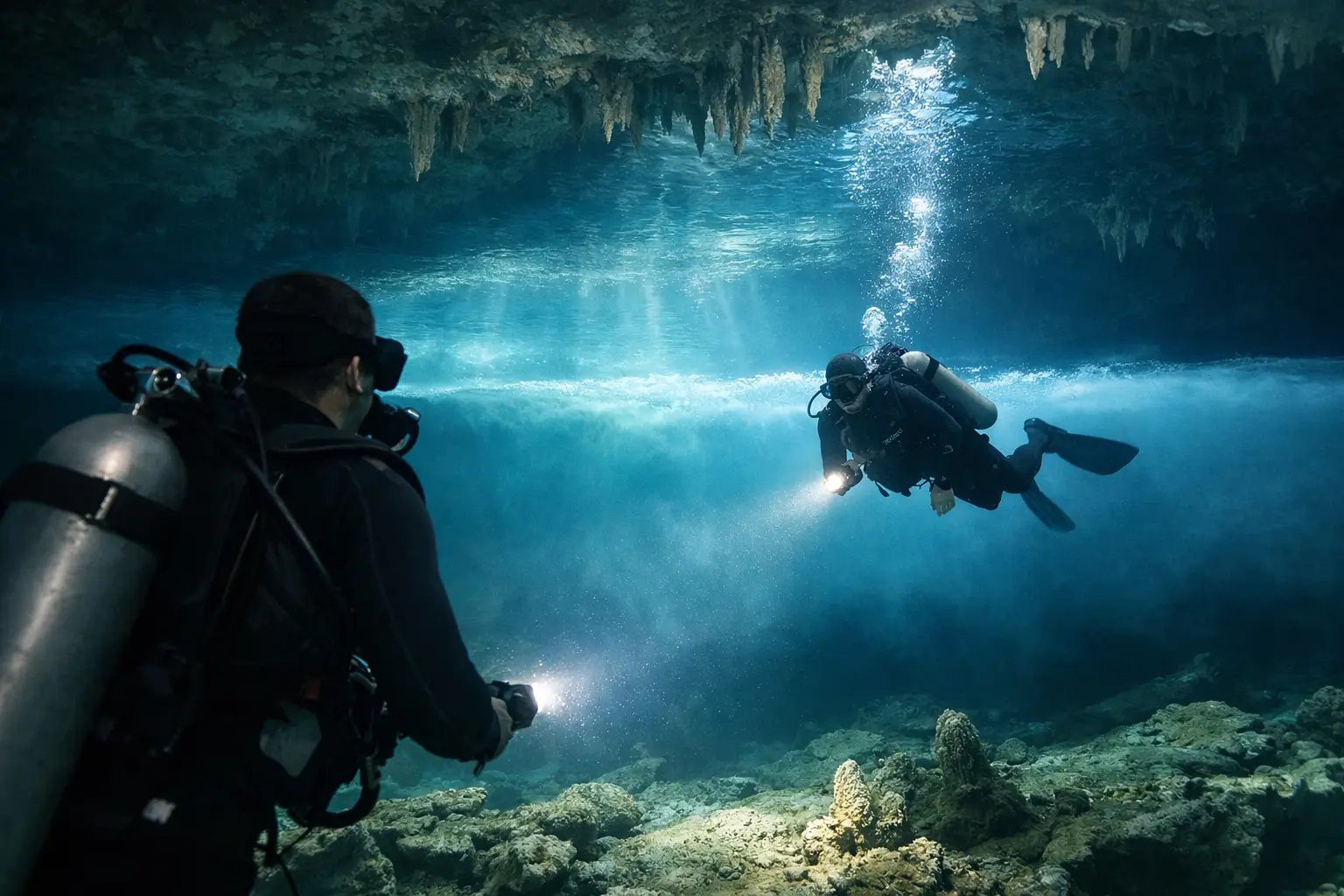
You are hovering in still, clear water when the cavern ahead seems to melt. Rock walls bend, your dive buddy’s outline shivers, and a bright, liquid-looking curtain ripples through the passage. Cenote haloclines explained simply: this breathtaking effect is the meeting point between waters with different salinity, usually fresh water above and salt water below.
For certified divers, passing through a halocline can be one of the most memorable moments in a Tulum cenote. It feels otherworldly, but it is not a special effect and it is not fog. It is natural science playing out in a limestone world shaped by rain, sea, and time.
What Is a Cenote Halocline?
A halocline is a boundary where water salinity changes sharply. In many Riviera Maya cenotes, rainwater filters slowly through porous limestone and collects as fresh groundwater. Beneath it, denser salt water can move inland from the Caribbean through underground pathways.
Fresh water is less dense than salt water, so it commonly sits above the saltier layer. The two bodies of water do mix over time, but not instantly. Where they meet, the change in salt concentration creates a visible, shifting boundary.
Divers often describe it as looking through heat waves above pavement, oil on water, or a distorted glass pane. Those comparisons are close, although the real experience is more immersive. Your mask may seem briefly out of focus, the cave formations can appear to wobble, and light from your dive torch may scatter across the layer in surprising ways.
The visual distortion happens because fresh and salt water bend light differently. This is called refraction. When your eyes look through layers with different refractive properties, the image reaching you is warped. The water itself has not turned cloudy. You are seeing an optical illusion created by a real physical boundary.
Why Haloclines Are So Common in Tulum Cenotes
The Yucatán Peninsula is a vast limestone platform rather than a region of rivers and lakes on the surface. Rainwater dissolves and travels through the rock, creating caves, passages, and sinkholes known as cenotes. Many of these systems connect, directly or indirectly, with the coast.
That geology creates ideal conditions for freshwater and saltwater layers to meet underground. But the exact location, thickness, and intensity of a halocline can change from cenote to cenote. It may appear as a thin shimmering line, a broad hazy-looking zone, or a dramatic layer that fills part of a cavern passage.
Depth is not a guarantee. In some sites, the halocline may be encountered relatively shallow; in others, it lies deeper or is less obvious. Seasonal rainfall, tides, water movement, and the individual structure of the cave system all influence what divers see that day.
This is one reason guided cenote diving is never just about checking off a famous site. A knowledgeable guide reads the day’s conditions, chooses an appropriate route, and helps divers appreciate what is happening around them without turning the experience into a rushed photo stop.
Halocline, Thermocline, and Hydrogen Sulfide: Know the Difference
These three phenomena are sometimes confused because all can appear as layers underwater. They are very different.
A halocline is caused by a change in salinity. Its signature is visual distortion, from slight shimmer to a dramatic wavy effect.
A thermocline is caused by a change in temperature. Divers may feel it as an abrupt cool or warm shift. Thermoclines can also affect visibility slightly, but the sensation of temperature change is usually the clearest clue.
A hydrogen sulfide layer is a cloudy, often milky layer created by decomposing organic matter in oxygen-poor water. Some cenotes are known for this surreal feature. It can look like a cloud lying over the bottom, but it is not the same thing as a halocline. A guide will plan the route and depth carefully, especially where layers and overhead environments combine.
More than one layer can exist in the same cenote. That is part of what makes these systems so fascinating. A single dive may move through clear fresh water, a distorted halocline, cooler water, and an atmospheric cloud-like layer, all while ancient limestone formations frame the route.
What It Feels Like to Swim Through One
The first time can be disorienting in the best possible way. As you enter the layer, visibility may seem to break apart around the edges of your vision. Your buddy can look stretched or blurred. The effect often becomes stronger when you move your hands or fins through the boundary because that motion temporarily mixes the layers.
The key is to stay calm and keep your dive skills steady. Look at your guide, your instruments, and the permanent features of the route rather than trying to chase the visual effect. The halocline is beautiful, but the cave or cavern environment still demands attention, buoyancy control, and team awareness.
For photographers, haloclines offer an exciting challenge. Wide shots can capture their ghostly texture, especially when light is angled across the layer. At the same time, photos rarely show exactly what your eyes perceive while moving through it. The distortion changes constantly, which is why many divers remember the sensation more vividly than any image.
How to Enjoy a Halocline Without Damaging the Cenote
Cenotes are delicate freshwater ecosystems, and their clarity depends on careful diving practices. Good buoyancy is not only a skill for looking polished underwater. It protects fragile formations, prevents silty bottoms from being disturbed, and keeps the water clear for everyone in the group.
As you approach a halocline, avoid sweeping your arms, kicking hard, or deliberately stirring the layer for a dramatic video. A gentle, controlled trim lets you experience the effect without creating unnecessary disturbance. Keep a respectful distance from formations and never hold onto rock, roots, or cave walls for balance.
Your guide may ask the group to move through a narrow section one at a time or maintain a particular depth. Follow that plan closely. In an overhead environment, strong positioning and calm finning matter far more than getting an extra second of footage.
Choosing an operator that treats cenote diving as more than an attraction makes a difference. At Infinity2Diving, guided experiences are built around proper briefing, route awareness, small-group attention, and the skills that help divers feel confident in these extraordinary environments.
Do You Need Special Training to See a Halocline?
You do not need to be a technical diver to see a halocline. Many recreational cenote dives include cavern routes designed for certified open-water divers, provided they meet the site requirements and dive within their training and comfort level.
However, a cenote is not the same as an open-water reef dive. Even on routes with natural light visible, there can be overhead sections, tight visual spaces, changing depth profiles, and strict environmental considerations. A professional guide will explain the route, emergency procedures, light signals, equipment setup, and the standards that keep the group together.
If you are newly certified, do not assume a cenote dive is beyond you, but be honest about your comfort in confined-looking spaces and your buoyancy control. A calm, transparent conversation with your dive team is the right place to start. Some divers benefit from a refresher or a few open-water dives first. Others are ready for a carefully selected cavern experience right away.
For divers who want to go beyond guided cavern routes, formal cavern and cave training is the path forward. That progression develops advanced buoyancy, propulsion techniques, gas management, navigation, emergency skills, and the judgment required for true overhead exploration. A halocline may be the moment that sparks your curiosity, but skill and discipline are what turn that curiosity into a responsible diving journey.
The Detail You Will Remember Long After the Dive
Cenote haloclines are a reminder that the most remarkable parts of a dive are not always the biggest animals or deepest depths. Sometimes they are a thin, shimmering boundary between two kinds of water, visible only because the light tells the truth differently on either side.
When you glide through one with a trained guide, steady buoyancy, and time to take it in, the feeling stays with you: a quiet moment where geology, ocean influence, and human wonder meet beneath the jungle.