
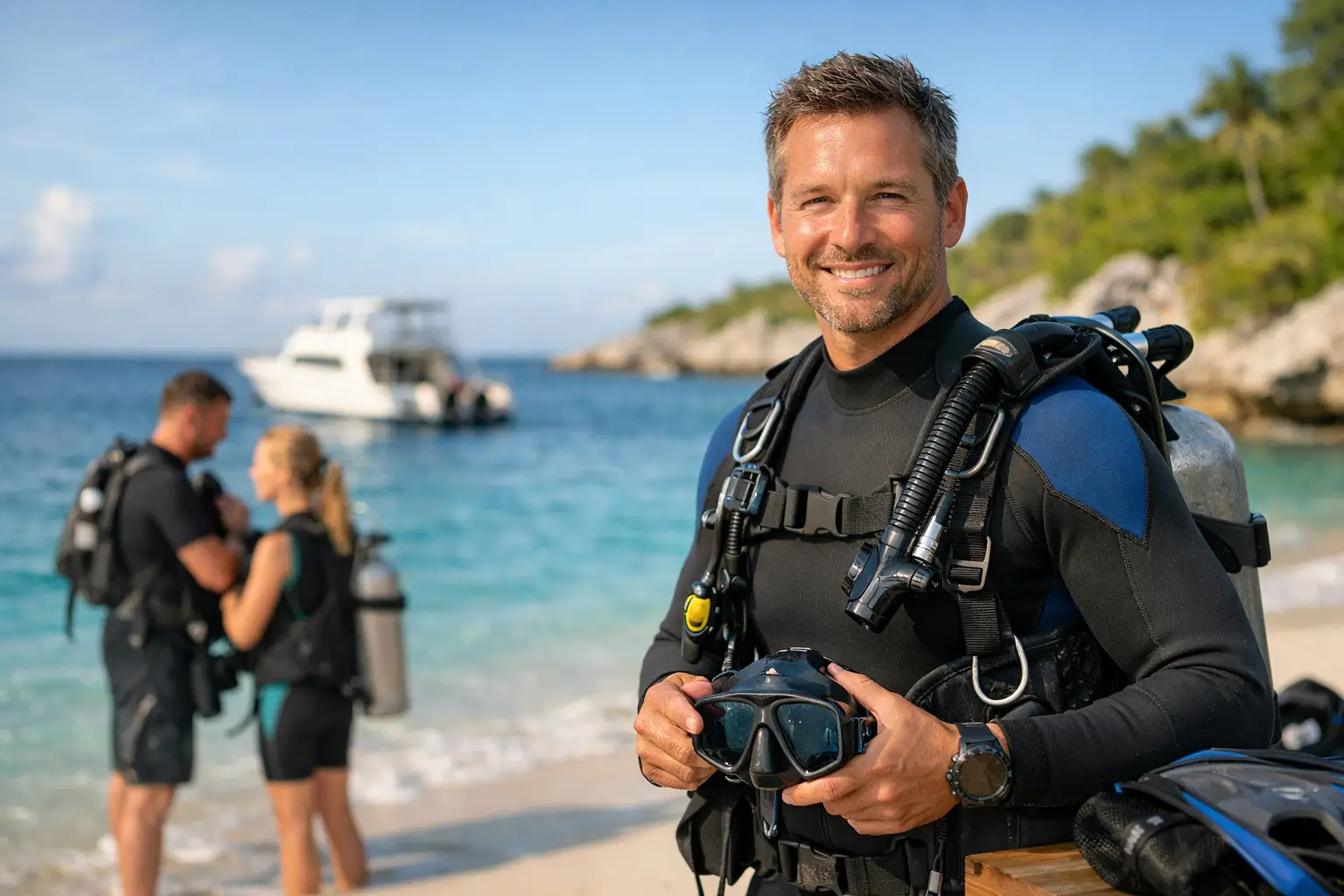
At 34, Maya had a stable office job, a lease, and the kind of calendar that left little room to breathe. She also had 60 logged dives, a growing feeling that her best days happened underwater, and one persistent question: could scuba become more than a vacation passion? This career switch dive instructor example follows the real decisions behind that question, from the first professional course to the work of building a sustainable life in diving.
Maya is a composite of many divers who arrive in Tulum with strong recreational skills and a desire for change. Her story is not a promise that everyone should quit their job. It is a clearer look at what a career change can involve when the dream is to teach people to breathe calmly, move confidently, and see an entirely new world beneath the surface.
Why a dive career can feel like the right next chapter
For many future instructors, the pull is not simply tropical water or travel photos. It is the moment a nervous beginner takes their first relaxed breath underwater. It is watching a student’s body language change from tense to capable. It is the satisfaction of becoming highly skilled at something that demands presence, judgment, and care for others.
Maya had spent years managing projects. She was good at it, but the work felt increasingly detached from what mattered to her. Diving gave her a direct connection to nature, a community built around shared experiences, and a challenge that never felt finished. She loved learning buoyancy, navigation, marine life identification, and the quiet discipline of planning a safe dive.
That said, loving to dive is not the same as loving the work of an instructor. Professional diving includes equipment handling, early mornings, paperwork, cleaning gear, adapting to weather, supporting students who are frightened, and following standards every single time. The people who thrive are usually drawn to service and teaching as much as they are drawn to the ocean.
Career switch dive instructor example: Maya’s path
Maya did not hand in her resignation after one great reef dive. First, she created a realistic runway. She saved enough to cover training, living expenses, travel, insurance, and several months without dependable income. She spoke with working dive professionals instead of relying on social media, and she asked direct questions about wages, seasonality, schedules, and where entry-level jobs actually come from.
She then mapped the professional PADI pathway. As an Advanced Open Water Diver, she already had some recreational experience, but she needed to continue progressing before she could start professional training. Her route included Rescue Diver, Emergency First Response training, more logged dives, and a current medical clearance where required. These milestones did more than check boxes. They developed the awareness and rescue skills that make a diver dependable underwater and on the surface.
Once she met the prerequisites, Maya enrolled in a PADI Divemaster program. This was the turning point. Divemaster training showed her the operational side of a dive center: assisting courses, guiding certified divers, setting up and managing dive activities, conducting briefings, anticipating problems, and modeling excellent dive skills. She learned that leadership in diving is not about being the loudest person in the group. It is about making every guest feel informed, seen, and safe.
Training in a destination such as Tulum added another dimension. Cenotes demand careful procedures, exceptional buoyancy, and respect for a fragile environment. Reef dives bring changing currents, boat logistics, and a broad range of guest experience levels. A quality professional program exposes candidates to the pace of real dive operations while giving them close mentorship, feedback, and room to improve.
After earning her Divemaster certification, Maya faced an honest choice. She could work for a season, build experience, and confirm that professional diving suited her day-to-day life. Or she could continue directly into an Instructor Development Course, followed by the Instructor Examination required to become a PADI Open Water Scuba Instructor. Neither route is automatically better. Taking time between levels can build confidence and practical experience; moving forward quickly can make sense for a prepared candidate with clear goals and a strong training environment.
Maya worked as a Divemaster first. She discovered that she loved assisting anxious students and leading small groups, but she also learned the physical rhythm of the job. Six days of lifting tanks, rinsing equipment, completing logs, and staying patient through long days felt very different from being a guest on a dive trip. That experience made her decision to become an instructor more informed, not less passionate.
What changes when diving becomes your job
The romantic version of the career is easy to picture: ocean views, colorful reefs, new friends, and a life that feels far from a desk. Those things can be part of it. But a professional instructor earns trust through consistency, preparation, and sound judgment.
Your dive count will grow, yet not every dive will be about your own exploration. Some will be confined-water sessions where a student needs to repeat a skill three times. Some will be rainy mornings spent checking equipment and changing plans. Some will be your chance to turn a difficult experience into a student’s proudest accomplishment.
Income can also vary widely by location, season, language skills, experience, and the dive center’s business model. Many new instructors combine teaching with guiding, retail, photography, content creation, equipment maintenance, or other hospitality work. Choosing a career center based only on the lowest course price can be costly later. Look for transparent inclusions, experienced mentors, a genuine safety culture, and meaningful opportunities to practice teaching rather than simply finish requirements.
The skills that make a new instructor employable
A certification qualifies you to teach within PADI standards. A strong professional reputation is built through how you show up for people. Employers and guests notice whether you are calm under pressure, organized before a course begins, and able to explain a skill in more than one way.
Language ability can make a major difference in international destinations. So can local knowledge, especially when guiding cenotes, reefs, or wrecks. A willingness to keep learning matters just as much. Specialty instructor ratings, first aid instruction, enriched air knowledge, and experience with different student needs can expand your options over time.
Most of all, protect the quality of the experience. The best instructors do not rush a nervous diver because the boat schedule is tight. They create an environment where questions are welcome, standards are respected, and students feel proud of earning their certification. That approach is safer, better for the guest, and better for a long-term career.
Building a plan before you make the leap
Before Maya left her office role, she wrote down the numbers. Her plan accounted for course fees, materials, gear purchases, professional membership costs, insurance, travel, accommodation, food, visas or work authorization, and an emergency fund. She also considered the opportunity cost of stepping away from a more predictable salary.
Then she set a test period instead of framing the move as irreversible. She committed to completing Divemaster training and working in diving for a defined season. If she still loved the teaching, guest care, and operational reality, she would continue to instructor level. If not, the training would still deepen her skills and give her a powerful personal achievement.
This mindset took pressure off the decision. A career switch does not need to be a reckless leap or a lifetime contract. It can be a disciplined experiment, supported by quality training and a clear financial plan.
At Infinity2Diving, future professionals can train in an environment that pairs world-class Riviera Maya diving with a structured PADI career pathway. The goal is not to hand someone a card and send them away. It is to help capable divers become confident leaders who can carry safety, curiosity, and respect for the underwater world into every course they teach.
Maya eventually became an instructor, but her biggest change was not the title on her certification. It was trusting herself to build a life around work that asked more of her and gave more back. If teaching diving keeps calling you, start by treating that dream with the seriousness it deserves. Take the next course, ask better questions, build your experience, and let every dive show you whether this is the path you are ready to lead.